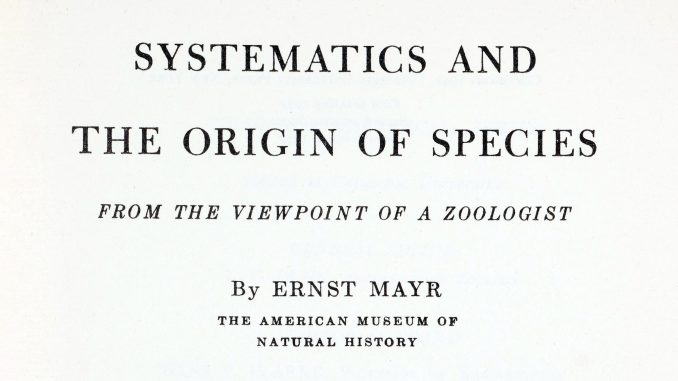
Ernst Mayr‘s (1904-2005) book, Systematics and the Origin of Species from the Viewpoint of a Zoologist was published in 1942 by Columbia University Press in their Columbia Biological Series. This book played an important part in the expansion of evolutionary studies in post-WW2 America and Britain, commonly referred to as the synthesis period in evolutionary biology.
In August 2026, I posed a series of questions to the Generative AI software, Google Notebook LM (now Gemini Notebook), about the text itself. One feature of this LLM is the ability to largely restrict content knowledge to a user-defined library, though some leakage is notable. In this case, that library consisted solely of the single volume described here. The replies are reproduced in full here.
Audio summary
This LLM also has capacity to produce AI-generated voice “deep dives” into the source materials. These are structured to sound as if two humans are having a conversation or making a podcast episode about the material. The prompt is “Provide a robust summary without reference to any other sources. Discuss use of most frequently referenced authors. Focus on concepts relevant for biology students.”
Questions about Mayr (1942) Systematics and the Origin of Species from the Viewpoint of a Zoologist
Summarise the book in 400 words or fewer.
Mayr champions the “new systematics,” shifting the focus of taxonomy away from static, morphological “types” to the study of variable, living populations in their natural environments. He formally introduces the biological species concept, defining species as “groups of actually or potentially interbreeding natural populations, which are reproductively isolated from other such groups”. To support this, he highlights the prevalence of the polytypic species—a species composed of multiple distinct geographic races (subspecies)—as proof of evolutionary continuity.
The core argument of the book is that speciation is almost exclusively geographic (allopatric). When a population becomes physically separated by geographic barriers, it gradually accumulates genetic and phenotypic differences. Over time, this divergence creates biological isolating mechanisms—such as ethological (behavioral), ecological, mechanical, or physiological barriers—that prevent the groups from interbreeding if they ever come back into contact. Mayr systematically dismantles the competing theory of sympatric speciation (speciation without geographic isolation), showing that most supposed examples are actually sibling species, ecophenotypes, or populations that were historically isolated.
Finally, Mayr explores widespread phenomena of geographic variation, such as continuous clines and ecological rules (e.g., Bergmann’s and Allen’s rules), to show that local populations continuously adapt to their environments. He concludes that there is no fundamental difference between microevolution and macroevolution; the emergence of higher taxonomic categories (like genera or families) is nothing more than the long-term extrapolation of these gradual, intraspecific speciation processes.
Summarise each chapter in 200 words or fewer.
Here is a summary of each chapter of Ernst Mayr’s Systematics and the Origin of Species from the Viewpoint of a Zoologist, based on the provided text:
Chapter I: The Methods and Principles of Systematics
Mayr describes the transition from the “old systematics,” which focused on static morphological types, to the “new systematics,” which treats variable, living populations as the basic taxonomic unit. He outlines the taxonomist’s fundamental tasks: identifying specimens, classifying them into a hierarchy, and investigating the factors of evolution and speciation.
Chapter II: Taxonomic Characters and Their Variation
This chapter emphasizes that taxonomists must account for the vast amount of individual variation within any population. Mayr distinguishes between non-genetic phenotypical modifications (such as age, seasonal variations, and habitat forms) and true heritable genetic variation. He argues that only heritable characters are relevant for evolutionary study.
Chapter III: Phenomena of Geographic Variation
Mayr demonstrates that geographically distant populations of the same species almost always differ. He reviews how morphological characters (size, proportions, pigmentation) and physiological traits vary across geography. Crucially, he asserts that this geographic variation has a genetic basis (mutations) and provides the raw material for speciation.
Chapter IV: Some Aspects of Geographic Variation
Mayr explores the populational aspects of continuous and discontinuous geographic variation, including polymorphism. He outlines “ecological rules” (like Bergmann’s and Allen’s) to demonstrate that geographic variation is frequently an adaptive response to local climates. He also introduces the concept of “clines” (character gradients) and examines how population structure affects variability.
Chapter V: The Systematic Categories and the New Species Concept
In this pivotal chapter, Mayr systematically dismantles the purely morphological (typological) species concept. He formally introduces the biological species concept, shifting the focus to reproductive isolation. He defines species as “groups of actually or potentially interbreeding natural populations, which are reproductively isolated from other such groups”.
Chapter VI: The Polytypic Species, in Nature and in Systematics
Mayr proves the widespread occurrence of polytypic species (species composed of multiple geographically representative subspecies). He demonstrates that adopting the polytypic species concept simplifies taxonomy, clears up nomenclatural chaos, and better reflects true evolutionary relationships by replacing thousands of narrowly defined “species” with comprehensive biological units.
Chapter VII: The Species in Evolution
This chapter analyzes the dynamics of geographic speciation. Mayr outlines the successive stages an isolated population undergoes to become a distinct species. He provides extensive proof for geographic speciation using phenomena like “sibling species,” double invasions of oceanic islands, and circular overlaps (ring species) where terminal populations overlap without interbreeding.
Chapter VIII: Nongeographic Speciation
Mayr examines alternatives to geographic speciation, such as sympatric, parapatric, and instantaneous speciation. While conceding that instantaneous speciation (e.g., polyploidy) occurs in some plants and invertebrates, he argues that for most animals, purported examples of sympatric speciation—such as “ecological races” or explosive species flocks in lakes—are usually artifacts of secondary overlaps or microgeographic isolation.
Chapter IX: The Biology of Speciation
This chapter reviews the ecological and behavioral factors that promote or impede speciation. Mayr contrasts external geographic barriers (like oceans and mountains) with internal biological isolating mechanisms—such as ethological (behavioral) incompatibilities, ecological preferences, mechanical factors, and sterility barriers—which prevent sympatric species from interbreeding.
Chapter X: The Higher Categories and Evolution
Extending the discussion to macroevolution, Mayr argues that higher taxonomic categories (like genera and families) are natural, monophyletic groups. He concludes that macroevolutionary processes are not driven by sudden saltations, but are simply the long-term extrapolation of the gradual, intra-specific processes of microevolution and speciation.
Identify the 6 most frequently referred to scientists in Mayr (1942) and their most cited works.
What are the five most cited items in this book?
Which organisms does Mayr refer to most frequently? This could be species, genus, family, order, class, etc., or just generic groups.
Birds (Aves) are by far the most frequently referenced organisms in the text. Mayr, an ornithologist, heavily utilizes his own research from the Whitney South Sea Expedition, as well as data from other bird taxonomists, to illustrate geographic variation, speciation, and population dynamics.
- Birds of Paradise and Bowerbirds (Paradisaea, Astrapia, Parotia, Diphyllodes, Seleucides) are frequently cited to discuss extreme morphological differentiation in isolated mountain habitats, altitudinal races, and intergeneric hybridization.
- Warblers (Phylloscopus, Sylvia, Acrocephalus, Dendroica, Vermivora) are often used to illustrate continuous clines, sibling species, and ecological or ethological isolation, such as differences in song or nest construction.
- Thickheads/Whistlers (Pachycephala) and Kingfishers (Tanysiptera, Halcyon) are heavily cited examples of island speciation and geographically variable polymorphism.
- Finches and Buntings (Geospiza, Zonotrichia, Junco) are used to explain continuous variation, archipelago speciation, and the influence of population size.
- Other frequently mentioned birds include gulls (Larus), white-eyes (Zosterops), thrushes (Turdus, Hylocichla), and geese/ducks (Branta, Chen, Anas).
Snails (Gastropods) are Mayr’s second most prominent group, providing ideal examples of highly sedentary, locally abundant populations.
- Tree Snails (Achatinella in Hawaii, Partula in Polynesia) illustrate extreme microgeographic races and localized archipelago speciation.
- Garden Snails (Cepaea nemoralis and hortensis) are primarily used to discuss neutral polymorphism, the consistency of polymorphic ratios over time, and sibling species.
- Freshwater Snails (Lymnaea) and other land snails (Clausilia, Arianta, Pagodulina) demonstrate the difference between true genetic geographic races and non-genetic habitat forms (ecophenotypes).
Insects (Arthropods) supply Mayr with extensive data on population genetics, sibling species, and biological races.
- Drosophila (Fruit Flies): Species like D. pseudoobscura and D. melanogaster are constantly referenced regarding genetic variability, chromosomal differences, temperature tolerance, and sibling species complexes.
- Lymantria dispar (Gypsy Moth): Used extensively—often via the work of Richard Goldschmidt—to discuss geographic variation in sex races, number of larval molts, and the time of larval development.
- Cynips (Gall Wasps): Sourced from Kinsey’s massive collections to illustrate polytypic species complexes, population size, and alternating parthenogenetic/bisexual generations.
- Carabus (Ground Beetles): Cited for physiological geographic races, such as temperature preference and phototaxis.
- Anopheles (Mosquitoes): The Anopheles maculipennis complex serves as Mayr’s premier example of “biological races” being unmasked as distinct sibling species.
- Bumblebees (Bombus) and Butterflies/Moths (Pieris, Papilio, Coenonympha) frequently illustrate polymorphism, clinal variation, and discontinuous variation.
Mammals are represented almost entirely by rodents, most notably Deer Mice (Peromyscus). Relying on the work of Dice and Sumner, Mayr uses Peromyscus to examine continuous character gradients, exact measurements of geographic variation, and adaptive coloration to specific backgrounds like dark lava flows or pale sand dunes.
Amphibians and Reptiles are used to demonstrate ecological overlap, hybridization, and physiological temperature races. Common examples include frogs (Rana), toads (Bufo), salamanders (Ambystoma), garter snakes (Thamnophis), rattlesnakes (Crotalus), and lizards (Lacerta).
Fish are occasionally referenced, particularly the live-bearer Platypoecilus to demonstrate the stability of polymorphic gene frequencies over decades, and the Cichlidae of the East African Lakes to debate the likelihood of explosive sympatric speciation.
What value is research on Drosophila for Mayr (1942)?
Map how Mayr applies these genetic insights to explain the geographic variations and subspeciation patterns of the Solomon Island whistler birds (Pachycephala pectoralis).
In Systematics and the Origin of Species (1942), Ernst Mayr uses the golden whistler (Pachycephala pectoralis) as a premier empirical showcase to explain geographic variation, subspeciation, and the gradual nature of species formation. With no less than 80 recognized subspecies across its entire range, it is highlighted as the most polytypic bird species known to science. In the Solomon Islands alone, Mayr maps out 10 distinct subspecies, applying several key genetic and evolutionary insights to explain their complex geographic patterns:
1. Independent Variation of Coloration Patterns (Genetic Mosaics)
Mayr explains that a bird’s complex color pattern is not inherited as a single, indivisible block, but is instead composed of many independent genetic elements that vary separately from one another. By utilizing data tabulated by Dobzhansky, Mayr illustrates how different Melano-Polynesian races of Pachycephala pectoralis exhibit unique mosaic combinations of throat, breast, back, and tail coloration, proving that geographic variation operates on separate gene loci independently.
2. Heterogynism (Differential Geographic Variation by Sex)
Mayr uses the Solomon Island whistler races to illustrate the phenomenon of heterogynism, where one sex (usually the female) exhibits far more striking geographic variation than the other.
- In the Solomon Islands, the males of the races bougainvillei, orioloides, and cinnamomea are morphologically indistinguishable.
- In contrast, the females of these same races vary dramatically: bougainvillei females are grayish-olive, orioloidesfemales are bright orange-yellow with a rufous wash, and cinnamomea females are pale gray with a rufous wash.
Mayr’s genetic explanation is that the males have reached a maximum threshold of pigmentation intensity where additional modifiers have no visible effect, whereas the females remain in a highly sensitive genetic zone where small physiological and pigmentary modifications are visually expressed.
3. Loss of Sexual Dimorphism through Genetic Drift
Normally, Pachycephala pectoralis exhibits strong sexual dimorphism; males possess a brilliant yellow, black, white, and olive pattern, while females are a dull yellowish ocher-olive. However, on the isolated Rennell Island, the race feminina occurs, in which the male has completely lost his ornamental plumage and has become “hen-feathered,” making him indistinguishable from the female (a process repeated independently on Norfolk Island by the race xanthoprocta).
Mayr explains this secondarily derived loss of dimorphism through two interacting factors:
- Genetic Drift in Small Populations: In highly isolated, small island populations, random genetic drift can overcome the selective pressure of sexual selection, allowing the genes for “hen-feathering” to become fixed.
- Absence of Competitors: This loss of conspicuous male plumage occurs only on islands where no similar, related species coexist. Because there are no competing species, a highly specific male nuptial plumage is no longer genetically required to function as a biological isolating mechanism to prevent cross-mating.
4. Secondary Hybridization and Stabilized Hybrid Populations
Mayr uses the whistlers to demonstrate what happens when geographic barriers break down or are crossed by a secondary wave of colonists before complete reproductive isolation has evolved. He identifies two distinct results of this process in the South Seas:
- Active Hybrid Zones: On Whitney Island, Mayr documents an active hybrid population resulting from the cross-breeding of Pachycephala pectoralis dahli and bougainvillei, proving that morphological divergence in geographic isolation does not automatically mean reproductive isolation has been finalized.
- Stabilized Hybrid Populations: On Koro Island in the Fiji group, Mayr explains the origin of the uniform, intermediate race koroana. Koro Island was originally occupied by the aurantiiventris group (characterized by a yellow throat and no black breastband) and was subsequently colonized a second time by the vitiensis group (white throat, black breastband). Rather than remaining a highly variable “melting pot,” the island’s isolated population eventually stabilized over time into a uniform, distinct new subspecies featuring an intermediate phenotype: a yellow throat combined with a black breastband.
Through these examples, Mayr demonstrates that the distinct insular populations of Pachycephala pectoralis in the Solomon Islands and greater Polynesia represent various gradual stages of speciation, with many of them standing directly on the threshold of becoming fully distinct, reproductively isolated species.
Analyze the 30 most frequently used and conceptually dominant scientific words (nouns, verbs, adjectives, and adverbs) that define Mayr’s 1942 text and recur throughout the provided chapters.
An analysis of the 30 conceptually dominant scientific words that define Ernst Mayr’s Systematics and the Origin of Species (1942) reveals how he systematically connected the fields of taxonomy, ecology, and population genetics. By categorizing these terms into nouns, verbs, adjectives, and adverbs, we can map the entire architecture of the “new systematics” and the biological species concept he pioneered.
I. CONCEPTUALLY DOMINANT NOUNS
- Species
The central unit of Mayr’s inquiry. He shifts the definition of a species from a static, morphologically defined “type” to a dynamic, biological entity consisting of actually or potentially interbreeding natural populations. - Population
The basic working unit of the “new systematics”. Mayr focuses on the local population (an adequate sample or “series” of which is studied in museums) as the potential interbreeding unit in nature. - Subspecies
A geographically localized, genetically distinct subdivision of a species. Mayr uses subspecies (synonymous with geographic races) to replace the subjective and chaotic “varieties” of older taxonomic systems. - Isolation
The critical barrier to random mating. Mayr places immense emphasis on isolation—distinguishing between extrinsic physical/geographical barriers and intrinsic physiological/biological isolating mechanisms—as a conditio sine qua non for speciation. - Variation (or Variability)
The continuous or discontinuous differences among organisms. Mayr analyzes both individual variation (within a population) and group variation (between populations) to explain evolutionary mechanisms. - Speciation
The gradual, non-cataclysmic evolutionary process of forming new species. Mayr outlines speciation as having two primary components: the origin of divergence (diversity) and the establishment of reproductive isolation (discontinuity). - Discontinuity
The “bridgeless gaps” that separate species coexisting at the same locality. Mayr defines the central problem of the “origin of species” as the origin of these biological discontinuities. - Character (or Characters)
The diagnostic morphological, physiological, or biological traits that systematists use to define taxonomic categories and trace paths of speciation. - Genetics
The experimental science of inheritance. Mayr emphasizes that the findings of genetics must be correlated with systematics to resolve the historic conflicts between laboratory geneticists and field taxonomists. - Systematics
The science of describing and classifying the organic world. Mayr redefines systematics as a theoretical and biological discipline rather than a mere “pigeonholing” or “museum cataloguing” routine. - Genus
A higher taxonomic category consisting of similar species of supposedly common monophyletic descent. Unlike species, Mayr notes that the boundaries of a genus are subjective and determined by taxonomic convenience. - Hybridization
The interbreeding of individuals from taxonomically distinct populations or species. Mayr studies zones of hybridization (secondary intergradation) to understand the breakdown of isolating barriers. - Selection
Natural selection, which Mayr views as the primary creative force that molds populations to fit their local geographical and ecological niches. - Polymorphism
The occurrence of several distinct phases or types coexisting within a single breeding population, representing a pronounced style of discontinuous individual variation. - Cline
A term introduced by Julian Huxley for character gradients. Mayr notes that clines indicate spatial continuity, meaning that regions with many clines often exhibit less active species formation.
II. CONCEPTUALLY DOMINANT VERBS
- Interbreed (or Intergrade)
The biological activity that defines species borders. Mayr defines species on the basis of whether populations actually or potentially interbreed or intergrade where they come into contact. - Isolate
The process of physically, ecologically, or behaviorally segregating populations, which Mayr argues is necessary for them to accumulate genetic differences. - Diverge
The process where isolated populations gradually accumulate distinct morphological or physiological characters over time. - Classify
The synthetic stage of systematics where species are arranged into a hierarchical, natural, and monophyletic system. - Differentiate
The developmental or genetic process of establishing differences between populations or genders under distinct selective environments.
III. CONCEPTUALLY DOMINANT ADJECTIVES
- Geographical
Reflecting Mayr’s core thesis that geographic variation and the physical isolation of populations are the near-universal catalysts for speciation in animals. - Biological
Characterizing Mayr’s new, dynamic approach to species. The biological species concept emphasizes reproductive isolation and ecological relationships over purely morphological definitions. - Morphological
Relating to physical structure and form. Mayr cautions against a purely morphological species concept, arguing that morphological differences are merely “visual clues” to underlying biological gaps. - Physiological
Relating to internal thresholds, developmental rates, and reaction norms. Mayr notes that physiological traits are highly adaptive and often act as crucial isolating barriers before morphological changes appear. - Adaptive
Possessing survival value. Mayr describes parallel geographic variations (such as Gloger’s and Bergmann’s rules) as adaptive results of natural selection by environmental gradients. - Sympatric
Describing species or populations that coexist geographically within the same area. Mayr emphasizes the absolute nature of the biological gap between sympatric species. - Allopatric
Describing species or populations that have mutually exclusive, non-overlapping geographic ranges. Mayr argues that allopatric populations represent the early stages of speciation. - Polytypic
A species composed of geographically replacing subspecies. The introduction of the polytypic species concept (Rassenkreise) was the major taxonomic revolution that simplified and clarified animal classification. - Phenotypic (or Phenotypical)
Relating to non-genetic variations (such as ecophenotypes or habitat modifications) that are temporary responses to local environmental factors like temperature or diet.
IV. CONCEPTUALLY DOMINANT ADVERBS
- Gradually (or Gradual)
Speciation is defined as a slow, gradual accumulation of genetic and ecological differences during geographic isolation, directly refuting saltationist or instantaneous theories of evolution.