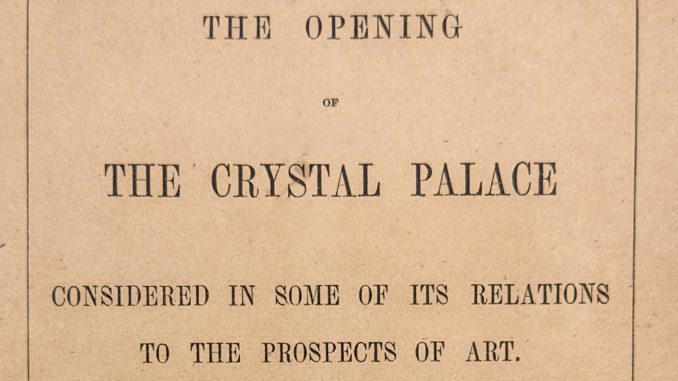
John Ruskin did not like the new Crystal Palace Sydenham when it opened in 1854. In Opening of the Crystal Palace (1854), he launches his critique, arguing that while the glass structure exhibits impressive mechanical ingenuity, it represents only a magnified conservatory rather than a noble new order of architecture. Ruskin laments that society praises such superficial, “sparkling” novelty while leaving original masterpieces to rot in London and Venetian paintings to decay in the rain.
- John Ruskin (1854) The Opening of the Crystal Palace Considered in Some of Its Relations to the Prospects of Art (London: Smith, Elder, and Co), 21pp plus 3p advertisements.
Below is a summary of his views as well as a complete pdf facsimile of his address.
Abstract
Ruskin warns that Europe’s greatest Gothic monuments are undergoing imitative “restorations” that are far more destructive than fire, war, or revolution. These inaccurate interventions, frequently driven by architects’ commercial self-interest, fail to reproduce the authentic spirit and pensive beauty of medieval craftsmanship. Simultaneously, modern desires for Parisian-style uniformity lead to the relentless demolition of historic domestic streets across Europe.
To halt this irreversible cultural loss, Ruskin proposes establishing a self-denying protective association. Funded by members who sacrifice personal collections and estate expansions, this society would deploy active “watchers” to document, purchase, and maintain endangered buildings through strictly necessary, non-destructive preservation. Ruskin urgently concludes that saving these historical monuments must be prioritized immediately, as once these stones are ground to dust, the spirit of past generations can never be recovered.
Ruskin’s Main Lines of Argument
The Contrast: Simple Human Existence vs. Industrial Progress
Ruskin opens his essay by contrasting his reading of The Times account of the Crystal Palace’s opening with his view of the simple, low larch huts nestled in the grassy slopes of Switzerland’s Simmenthal. He identifies a profound tension between Swiss peasants quietly contending with Nature for their existence (retaining the same humble, generational thoughts) and the “great multitude” of modern progress who command Nature for recreation, haughty with hope of endless power and progress.
The Promise and Pitfalls of the Crystal Palace
While Ruskin acknowledges the immense, hopeful potential of the Crystal Palace as a grand national museum that could provide the working classes with healthy country air, intellectual recreation, and direct access to scientific and artistic knowledge, he is deeply despondent about the state of modern art and taste. He laments that after three hundred years of scrupulous investigation, discussion, and imitation of architectural history, the peak achievement of nineteenth-century architectural “invention” is merely a “magnified conservatory”. He criticizes the popular view — encouraged by contemporary professors of art and articulated at the opening — that the palace of glass represents a novel order of architecture. In his view, Doric and Palladian pride have been reduced to being dazzled by rows of glass panes, mistaking “sparkling” and “space” for the core principles of architectural sublimity.
Mechanical Ingenuity vs. True Art
Ruskin stresses that mechanical ingenuity and grand dimensions—while admirable in works like screw frigates and tubular bridges—should not be confused with poetry or art. Roofs of crystal and bridges of iron do not guarantee the creation of a Milton or a Michael Angelo. To illustrate this cultural misplaced priority, he notes that while Britain erected its massive glass palace to exhibit the “petty arts” of fashionable luxury, the nation left the invaluable works of J.M.W. Turner (who died in 1851) to rot in a dark Cavendish Square room under the care of an old servant. Similarly, Venetian masterpieces were allowed to decay in Venice for want of simple roofs to protect them from rain and cannon fire.
The Tragedy of Architectural “Restoration”
A central and urgent focus of the essay is the irreparable harm caused by the “restoration” of true Christian and Gothic architecture in Europe, particularly the grand cathedrals of France such as Rheims, Amiens, Rouen, Chartres, and Paris. Ruskin argues that these extensive, well-meaning, and highly-funded repairs are more destructive than fire, war, or revolution. They operate under the false antiquarian assumption that it is possible to reproduce mutilated medieval sculptures “with mathematical exactitude”. He compares this to pulling down the Elgin Marbles or Melrose Abbey to build facsimiles elsewhere; instead, original fragments and ruins should be left untouched, and only structural or protective measures (such as propping, substituting essential structural stones, or clearing weeds and water channels) should be performed.
The Commercial Incentives and Loss of Spirit
Modern restorations are frequently driven by financial and professional incentives rather than a love for the monuments. While simple, protective repairs are unsightly and rarely win public approval, full-scale restorations guarantee architects long-term commissions, vast patronage, and steady incomes, creating a permanent economic incentive for destruction. Moreover, even if architects and workers are completely honest, modern workmen lack the feeling, intention, and spirit of the 13th-century freemasons. A restored facsimile can never possess the historical and emotional value of the original stone lifted into place in the presence of historical figures like St. Louis. Those who truly understand the value of these monuments, like a poor village abbé, have no influence over public affairs, which are left to bustling mayors and prosperous architects. Using the north transept of Rouen Cathedral as a personal example, Ruskin highlights how its exquisite, natural decay has been stripped away in favour of inaccurate, novel white “restorations”.
A Culture Repulsed by the Past
Ruskin laments that the solemn, reflective aspect of ancient architecture has become repulsive to modern Europeans who seek to chasten reflection and indulge in frivolity. The wealthy classes of Europe strive to turn every historic city into a replica of the Parisian Champs Élysées, tearing down old buildings to construct vast hotel barracks, formal streets, and theatres upon desecrated chapels. This homogenization destroys medieval domestic timber architectures, such as those in Venice, Florence, Geneva, Lucerne, and Rouen. He fears that travellers are losing the true purpose of travel—trading history and contemplation for billiard-rooms, cafes, and ballrooms. If this trend continues, the twentieth century will look upon a “world without a record and without a ruin,” leading to an ephemeral, record-less existence centred on eating, drinking, and dying. He asks why Europe—a narrow pavement “gilded with the blood of old battles, and grey with the temples of old pieties”—must be swept clean when America and Asia offer plenty of space for modern expansion and power.
A Call to Action for European Heritage
Because the damage being done is entirely irreparable, Ruskin warns that by the time newly founded art schools and museums teach the public to discern true art, they will only have copies, casts, and ruins of ruined masterpieces left to look at. To address this emergency, he proposes the creation of an active, self-denying protective association. This society would employ active “watchers” across Europe to keep records and reports of historical monuments, raise funds to buy endangered properties, and assist owners in proper, non-destructive maintenance. Such a society would require its members to practice self-denial, giving up personal art purchases or the expansion of their own estates to save monuments they might never personally see.
Ruskin concludes with an urgent plea: the next five years will decide what is preserved and what is lost forever. Protective endeavours are more critical than teaching, criticizing, or inventing, because while we can always create in the future, we can only preserve now. No amount of national wealth or imperial power can ever gather together the stones stamped with the spirit of our ancestors once they have been ground to dust.
Ruskin’s Calls to Action
Ruskin concludes with a passionate, urgent appeal to halt the destruction of European heritage. To combat this crisis, he lays out five primary calls to action:
- Cease all imitative restorations and leave original ruins untouched: Ruskin argues that instead of trying to “reproduce” old work with mathematical accuracy—which only results in inaccurate, dead copies—we must leave original fragments and historical ruins entirely unharmed. Modern or imitative sculpture must never, under any circumstances, be mingled with ancient work.
- Limit repairs strictly to essential, non-destructive structural support: Rather than executing complete aesthetic overhauls, repairs should be limited strictly to what is necessary for safety. This includes substituting new stones only when essential to stability, using wooden or metal props, cementing loose pieces back in place, and performing basic maintenance like clearing weeds and rain gutters.
- Establish an organised association of “active watchers”: Ruskin calls for the immediate formation of a dedicated preservation society with active agents stationed in every major European town. These watchers would maintain a running inventory of historical monuments and supply the society with yearly or half-yearly reports on their condition and any threatened changes.
- Raise collective funds to purchase endangered properties and assist owners: The proposed association must raise funds specifically to buy the freeholds of vulnerable historical buildings or untransferable art. These funds would also be used to assist private owners and public bodies in financing the practical, non-destructive structural guardianship needed to keep their buildings safe.
- Commit to personal self-denial and financial sacrifice: Ruskin demands that those who care about art and history divert their wealth away from private luxury. He calls on members to willingly sacrifice the expansion of their own estates and give up purchasing prints or paintings for their own walls, choosing instead to fund the preservation of historic masterpieces across Europe that they themselves may never even see.
Nb: Text in accordions was produced by GoogleNotebook, then edited for value.
Read Ruskin (1854) The Opening of the Crystal Palace
This is the full text of Ruskin’s address. It is a large file (13Mb), and it may take a minute otherwise load. An alternative location is Internet Archive. A second rendition has become available also in Internet Archive.