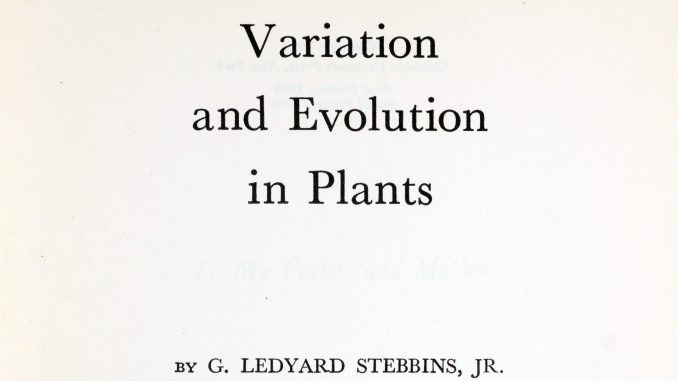
G. Ledyard Stebbins‘ (1906-2000) book, Variation and Evolution in Plants, was published in 1950 by Columbia University Press in their Columbia Biological Series. This book played an important part in the expansion of evolutionary studies in post-WW2 America and Britain, commonly referred to as the synthesis period in evolutionary biology.
In August 2026, I posed a series of questions to the Generative AI software, Google Notebook LM (now Gemini Notebook), about the text itself. One feature of this LLM is the ability to largely restrict content knowledge to a user-defined library, though some leakage is notable. In this case, that library consisted solely of the single volume described here. The replies are reproduced in full here.
Audio summary
This LLM also has capacity to produce AI-generated voice “deep dives” into the source materials. These are structured to sound as if two humans are having a conversation or making a podcast episode about the material. The prompt is “Provide a robust summary without reference to any other sources. Discuss use of most frequently referenced authors. Focus on concepts relevant for biology students.”
Summarise the book in 400 words or fewer.
G. Ledyard Stebbins’s 1950 book, Variation and Evolution in Plants, provides a comprehensive synthesis of modern evolutionary theory applied to the plant kingdom. Stebbins argues that plant evolution must be analyzed on three interacting levels: individual variation (mutation and recombination), microevolution within populations (natural selection), and macroevolution or species formation (isolating mechanisms).
Evolution progresses through the accumulation of small genetic changes rather than sudden leaps. Stebbins describes it as “progressive opportunism,” directed by the interaction of genetic variability and environmental shifts. While mutation provides the ultimate raw material, genetic recombination is the immediate source of variability upon which selection acts.
A major portion of the book examines natural selection, emphasizing that it operates on combinations of characters. Stebbins illustrates this with Camelina sativa, a weed that evolved specific traits mimicking cultivated flax due to the selective pressures of human agricultural practices like winnowing.
Stebbins extensively analyzes “genetic systems,” noting that plants display a greater diversity of reproductive strategies than animals. He explores the evolutionary compromises plants make between immediate environmental “fitness” and long-term “flexibility”. This framework explains the selective advantages of cross-fertilization, self-fertilization, asexual reproduction, and structural hybridity (such as the complex chromosome rings in Oenothera).
The origin of species is defined by the development of isolating mechanisms—both external (spatial and ecological) and internal (such as cryptic structural hybridity and hybrid sterility). Furthermore, Stebbins highlights “introgressive hybridization” as a potent evolutionary force, noting that hybrid survival is strongly promoted by the creation of new habitats following natural catastrophes or human disturbance.
Addressing phenomena vital to plant evolution, Stebbins devotes significant attention to polyploidy and apomixis. He maps the complex variation patterns of agamic (apomictic) complexes, contrasting the historically recent, geographically restricted Crepis complex with the older, more widespread Rubus complex. Finally, analyzing long-term evolutionary trends in karyotypes and morphology, Stebbins rejects orthogenesis in favor of natural selection. By integrating fossil evidence, he concludes that varying rates of evolution are ultimately determined by the dynamic relationship between a population’s genetic structure and its changing environment.
Summarise each chapter in 200 words or fewer.
Based on G. Ledyard Stebbins’s 1950 book, Variation and Evolution in Plants, here is a summary of each chapter:
Chapter I: Description and Analysis of Variation Patterns
Chapter I describes the transition from traditional morphology to the study of multidimensional patterns of variation in nature. It outlines how taxonomists use morphological, cytological, serological, and distributional characters to chart these patterns. Stebbins emphasizes quantitative methods and defines the interbreeding population as the fundamental evolutionary unit, contrasting its dynamic nature with static taxonomic categories.
Chapter II: Examples of Variation Patterns within Species and Genera
Chapter II illustrates the principles of variation using specific plant groups. It explores ecotypic and clinal variation, showing how species are subdivided into locally adapted ecotypes and subspecies. The chapter provides specific examples of variation patterns in the families Ranunculaceae and Gramineae, and the genera Potentilla, Layia, and Quercus, noting how species like oaks frequently intergrade through natural hybridization while maintaining their taxonomic identity.
Chapter III: The Basis of Individual Variation
Chapter III investigates the fundamental raw materials of evolution. It distinguishes between non-heritable environmental modifications and true genetic variation, emphasizing the importance of genetic recombination. Stebbins details various mutations—ranging from submicroscopic chemical changes to gross chromosomal rearrangements, aneuploidy, and polyploidy—and discusses their genetic effects and natural rates of occurrence.
Chapter IV: Natural Selection and Variation in Populations
Chapter IV traces the role of natural selection, arguing that it is a creative force that molds random mutations into adaptive systems. Stebbins uses experimental data (like barley survivorship) and historical evidence (like Camelina sativa evolving to mimic flax) to demonstrate selection in action. He explains how selective correlation and adaptive compensation shape both vegetative and reproductive traits within populations.
Chapter V: Genetic Systems as Factors in Evolution
Chapter V analyzes evolution as a necessary compromise between immediate environmental fitness and long-term evolutionary flexibility. It discusses the selective advantages of different genetic systems, comparing asexual reproduction, haploidy, diploidy, heterokaryosis, and cross- versus self-fertilization. Stebbins introduces the “recombination index” to explain how genetic systems govern the flow of variability in plant populations.
Chapter VI: Isolation and the Origin of Species
Chapter VI distinguishes speciation from general evolution, defining a species as a system of interbreeding populations separated from others by gaps in genetic continuity. It outlines the various isolating mechanisms that prevent gene interchange, including spatial, ecological, seasonal, and mechanical isolation, as well as hybrid inviability and cryptic structural hybridity. Stebbins discusses how these barriers originate and finalize evolutionary divergence.
Chapter VII: Hybridization and Its Effects
Chapter VII evaluates the evolutionary impact of crossing between genetically unlike individuals or species. It highlights “introgressive hybridization”—the gradual infiltration of genes from one species into another—using examples like Cistus. Stebbins argues that hybridization, particularly when hybrids colonize new or disturbed habitats, acts as a major catalyst for creating new adaptive types and modifying isolating barriers.
Chapter VIII: Polyploidy I: Occurrence and Nature of Polyploid Types
Chapter VIII examines the widespread occurrence of polyploidy (chromosome multiplication) in the plant kingdom. It classifies polyploids into four main types: autopolyploids, allopolyploids, segmental allopolyploids, and autoallopolyploids. Stebbins details the direct physical effects of genome doubling and explains how hybridization combined with polyploidy produces complex, highly successful “polyploid complexes”.
Chapter IX: Polyploidy II: Geographic Distribution and Significance of Polyploidy
Chapter IX explores how polyploid plants often possess different geographic distributions and ecological tolerances compared to their diploid ancestors. It evaluates polyploidy as evidence for former distributional patterns (such as Pleistocene glaciation survival) and discusses the factors determining its spread. Stebbins also contrasts the high frequency of polyploidy in plants with its general rarity in animals.
Chapter X: Apomixis in Relation to Variation and Evolution
Chapter X investigates apomixis, the process of asexual reproduction through seeds (agamospermy) or vegetative means. It details the genetic basis of apomixis and its frequent association with hybridization and polyploidy to form “agamic complexes” in genera like Crepis. Stebbins discusses how apomixis complicates species concepts and provides colonizing advantages at the expense of long-term evolutionary flexibility.
Chapter XI: Structural Hybridity and the Genetic System
Chapter XI focuses on structural chromosomal changes, such as inversions and translocations, as evolutionary mechanisms. It centers heavily on the complex-heterozygote systems found in Oenothera. Stebbins explains how alternate chromosome segregation at meiosis, combined with balanced lethals, allows these plants to maintain specific, highly adapted heterozygous gene combinations intact across generations.
Chapter XII: Evolutionary Trends I: The Karyotype
Chapter XII analyzes the karyotype (the chromosome complement) as a direct evolutionary indicator. It discusses widespread phylogenetic trends, including ascending and descending aneuploid changes in basic chromosome numbers. The chapter also reviews evolutionary alterations in absolute and relative chromosome size, the development of asymmetric karyotypes, and variations in the resting and prophase nucleus.
Chapter XIII: Evolutionary Trends II: External Morphology
Chapter XIII reviews broad morphological trends in vascular plants, evaluating concepts like orthogenesis, the principle of irreversibility, and embryonic similarity (recapitulation). It argues that the differentiation of major plant families—such as the evolution of specific floral, fruit, and branching structures—results from natural selection acting on developmental correlations to create integrated adaptive systems.
Chapter XIV: Fossils, Modern Distribution Patterns and Rates of Evolution
Chapter XIV connects modern geographic distribution and paleobotanical records to understand the speed of evolution. It discusses disjunct distributions, the impact of changing Tertiary climates, and the historical displacement of floras. Finally, Stebbins evaluates the specific environmental and biological conditions that cause evolutionary rates to become exceptionally rapid or exceptionally slow.
Identify the 6 most frequently referred to scientists in this work and their most cited works. (Treat Clausen, Keck, and Hiesey as one “author” in this case.)
1. G. Ledyard Stebbins, Jr.
As the author of the book, Stebbins heavily cites his own extensive prior research—both solo and collaborative—to build the foundation of his synthesis on plant evolution, polyploidy, and apomixis.
Most Cited Works:
- The significance of polyploidy in plant evolution (1940)
- Apomixis in the angiosperms (1941)
- The role of isolation in the differentiation of plant species (1942)
- Types of polyploids: their classification and significance (1947)
2. Jens Clausen, David D. Keck, and William M. Hiesey
Treated as a single collaborative “author,” this Carnegie Institution of Washington research team provides the foundational experimental data for the book. Stebbins relies heavily on their pioneering transplant experiments and their definitions of biosystematic units—ecotypes, ecospecies, cenospecies, and amphiploids.
Most Cited Works:
- Experimental studies on the nature of species. I. The effect of varied environments on western North American plants (1940)
- Experimental studies on the nature of species. II. Plant evolution through amphiploidy and autoploidy (1945a)
- The concept of species based on experiment (1939)
3. Edgar Anderson
Anderson is the most frequently cited individual researcher aside from Stebbins himself, with 24 distinct works listed in the bibliography. Stebbins relies heavily on Anderson’s quantitative methods for descriptive systematics (such as the “hybrid index”) and his fundamental theories regarding the evolutionary importance of introgressive hybridization.
Most Cited Works:
- Introgressive hybridization (1949)
- The technique and use of mass collections in plant taxonomy (1941)
- Hybridization in American Tradescantias (1936c)
4. C. D. Darlington
A premier cytologist, Darlington is cited extensively (13 works) for his theories on chromosome mechanics, genetic systems, and structural hybridity. Stebbins uses his work to explain complex meiotic behaviors, such as secondary chromosome association and the mechanics of crossing-over in the complex-heterozygote rings of Oenothera.
Most Cited Works:
- Recent advances in cytology (1937)
- The evolution of genetic systems (1939)
- Chromosomal behavior and structural hybridity in the Tradescantiae (1929)
5. Ernest B. Babcock
Babcock is a leading authority on the genetics and phylogeny of the genus Crepis. Stebbins, who frequently collaborated with Babcock, uses his “monumental work” on Crepis as the primary botanical model for understanding aneuploid chromosome reduction, the “polyploid complex,” and agamic (apomictic) complexes.
Most Cited Works:
- The Genus Crepis, I and II (1947)
- The American species of Crepis: their relationships and distribution as affected by polyploidy and apomixis(with Stebbins, 1938)
6. Theodosius Dobzhansky
Dobzhansky serves as Stebbins’s primary authority on the mechanics of population genetics, genetic drift, and the classification of reproductive isolating mechanisms. Stebbins frequently uses Dobzhansky’s zoological data on Drosophila to corroborate evolutionary rules in plant populations, and credits him for extensive assistance and encouragement in the book’s preface. Most Cited Works:
- Genetics and the origin of species (1941 revised edition)
- Genetics of natural populations (an ongoing series of papers, including specific studies co-authored with C. Epling in 1942 and S. Wright in 1946).
(Note: If evaluated strictly by the number of individual publications in the bibliography, the Swedish geneticist Åke Gustafsson also ranks exceptionally high with 16 cited works, relied upon primarily for his comprehensive analyses of apomixis and the intricate genetic systems of the Rosa canina complex).
What are the five most cited items in this book?
While the provided text does not contain a complete index to provide an exact numerical tally of every citation, it reveals the five specific publications that Stebbins relies on most heavily to build his theoretical framework and support his arguments:
1. Theodosius Dobzhansky, Genetics and the Origin of Species (1941 revised edition) Dobzhansky’s book is Stebbins’s primary authority on the mechanics of population genetics. It is cited extensively to explain the random fluctuation of gene frequencies (genetic drift), to classify reproductive isolating mechanisms, and to refute the idea of sudden “macromutations” or orthogenesis.
2. Jens Clausen, David D. Keck, and William M. Hiesey, Experimental studies on the nature of species. I. The effect of varied environments on western North American plants (1940) This landmark publication by the Carnegie Institution of Washington research team provides the foundational experimental data for the book. Stebbins relies on it heavily to discuss transplant experiments, environmental modification, and the definitions of biosystematic units such as ecotypes and ecospecies.
3. George Gaylord Simpson, Tempo and Mode in Evolution (1944) In his final chapters, Stebbins relies almost entirely on Simpson’s work to analyze the speed of evolution. He uses Simpson’s concepts of evolutionary rates (horotely, bradytely, and tachytely), his evaluation of the fossil record, and his arguments against orthogenesis, applying Simpson’s zoological conclusions to the plant kingdom.
4. C. D. Darlington, The Evolution of Genetic Systems (1939) Stebbins explicitly states that his own chapter on genetic systems is built upon the principles laid out in Darlington’s book. He cites it frequently to explain the fundamental evolutionary “compromise” plants must make between immediate environmental fitness and long-term evolutionary flexibility.
5. Ernest B. Babcock, The Genus Crepis, I and II (1947) Babcock’s monumental two-volume monograph serves as Stebbins’s primary botanical model. He utilizes Babcock’s exhaustive data on Crepis to illustrate the mechanics of the “polyploid complex,” the variation patterns of apomictic reproduction, and the phylogenetic reduction of chromosome numbers in karyotype evolution.
Which organisms does Stebbins refer to most frequently? This could be species, genus, family, order, class, etc., or just generic groups.
Based on the provided excerpts from Stebbins’s 1950 book, he draws upon a wide variety of plant groups to illustrate different evolutionary mechanisms. However, several specific genera and families are referred to most frequently to demonstrate his core concepts:
1. Crepis (Hawk’s-beards) and the Family Compositae Stebbins calls Crepis the “most thoroughly studied of the larger genera of angiosperms”. He relies on it heavily throughout the text to illustrate two major evolutionary phenomena:
- Karyotype Evolution: Crepis provides his primary model for showing how the basic haploid chromosome number can be phylogenetically reduced (from x=6 down to x=3) in correlation with increasing morphological specialization (such as shifts from perennial to annual habits or specialized fruits).
- Agamic (Apomictic) Complexes: He contrasts the clearly defined diploid sexual species of Crepis with the massive, interconnected superstructure of polyploid apomicts (plants reproducing asexually via seed) to explain complex variation patterns. Other members of the Compositae (Sunflower family) are also frequently cited, including Achillea for demonstrating clinal and ecotypic variation at different altitudes, and Layia and Wyethiato demonstrate genetic isolation and species relationships.
2. Oenothera (Evening Primroses) Stebbins uses the subgenus Euoenothera as his “classic group of plants for studies of hybridity for segmental interchanges”. He uses it extensively to explain the unique genetic system of complex-heterozygotes—plants that maintain genetic heterozygosity through the formation of large rings of chromosomes during meiosis and balanced lethal mechanisms.
3. Potentilla and Rubus (Family Rosaceae) The Rose family is frequently discussed for its high frequency of polyploidy and apomixis.
- Potentilla glandulosa is Stebbins’s premier example for explaining the ecotype concept. He frequently cites the transplant experiments of Clausen, Keck, and Hiesey to show how this species is divided into distinct, genetically adapted subspecies across different altitudes and environments in California.
- Rubus (blackberries and raspberries) is heavily cited alongside Crepis to compare the massive, complicated variation patterns created by facultative apomixis and polyploidy.
4. The Grass Family (Gramineae) Stebbins notes that the grass family probably has the highest proportion of polyploid species of any family of angiosperms.
- Genera such as Bromus, Festuca, Agropyron, Elymus, and Hordeum (barley) are frequently used to contrast the evolutionary effects of self-fertilization versus cross-fertilization.
- Stipa is highlighted for demonstrating an extensive aneuploid series (gradual variation in chromosome numbers).
5. Camelina (False Flax) To illustrate the direct action of natural selection, Stebbins devotes significant attention to the mustard genus Camelina. He details how certain subspecies of Camelina sativa evolved specifically as weeds in cultivated flax fields, genetically adapting to mimic the flax plants in growth habit, seed size, and harvesting times.
6. Quercus (Oaks) and Aquilegia (Columbines) Stebbins frequently groups these two genera together as examples of plants where isolating barriers between species are incredibly weak or absent.
- He uses Aquilegia to describe a “cenospecies” where morphologically distinct populations can intercross freely and yield highly fertile hybrids.
- He uses Quercus to illustrate how many widespread, sympatric species (like the red, black, and white oaks) frequently form hybrid swarms in nature but mysteriously maintain their specific identities through ecological isolation rather than strict genetic barriers.
7. Paeonia (Peonies) and Delphinium (Larkspurs) These primitive angiosperm genera (from the Ranales order) are frequently used to demonstrate speciation, structural hybridity, and the varying strengths of genetic barriers at the simple, diploid chromosomal level.
What value is research on Drosophila for Stebbins?
For G. Ledyard Stebbins, research on Drosophila serves as a foundational source of experimental and observational genetic data. Because the genetic mechanisms of plants and animals are fundamentally similar, he frequently uses Drosophila to provide clear proof of evolutionary mechanisms that he either applies directly to plant populations or uses as a point of contrast.
He values Drosophila research in several key areas:
- The Nature and Detection of Mutations: Stebbins uses Drosophila experiments to confirm the frequent occurrence of “small mutations” in natural populations. He notes that “minute deficiencies” which simulate gene mutations have been produced by Drosophila researchers, and that chromosomal duplications are most easily detected in the giant salivary gland chromosomes of these flies. Additionally, he references Drosophilamutants with radical changes (such as flies born with four wings instead of two) as examples of “large” or systemic mutations, although he argues against Richard Goldschmidt’s view that such massive mutations are the primary drivers of species formation.
- Demonstrating Natural Selection in Action: Experiments by Dobzhansky and Spassky on D. pseudoobscuraare used to prove that beneficial mutations can arise and improve a population’s viability, demonstrating that mutations which might normally be eliminated can have a high selective value if the genotype is placed in a new or subnormal environment. Furthermore, he cites experiments by Payne and Mather on Drosophila to demonstrate that natural selection is a creative force; it can be continuously effective in cross-breeding populations because it acts on the vast combinations of the existing “gene fund,” rather than relying purely on sudden, new mutational steps.
- Selection Pressures and Mutation Rates: Stebbins relies on Berg’s studies of D. melanogaster in Armenia to show that mutation rates themselves are influenced by natural selection and population size. Small, isolated populations living under severe selection pressure were found to have lower mutation rates than larger populations in favorable environments.
- The Dynamics of Chromosomal Inversions: Stebbins leans heavily on Dobzhansky’s research to explain how natural selection maintains structural heterozygosity. In wild populations of D. pseudoobscura, the frequencies of different chromosomal inversion types undergo rapid seasonal changes driven by very high selection pressures. He points out that these inversion heterozygotes survive because they successfully link together and preserve superior gene combinations—a highly complex situation that he notes had not yet been detected in plants.
- Defining “Cryptic Species”: He cites D. pseudoobscura and D. persimilis as the classic genetic example of “cryptic species”—populations that appear morphologically identical but are actually distinct species separated by invisible genetic isolating mechanisms.
- Contrasting Plant and Animal Genetics: He occasionally uses Drosophila to highlight genetic phenomena that are surprisingly rare in plants. For instance, he notes that the “position effect” (where the phenotypic effect of a gene changes depending on its physical position in the chromosome) is of considerable importance in Drosophila, but has only been clearly demonstrated in one plant genus, Oenothera.
Analyze the 30 most frequently used and conceptually dominant scientific words (nouns, verbs, adjectives, and adverbs) that define Stebbins’s 1950 text and recur throughout the provided chapters.
An analysis of the 30 conceptually dominant scientific words that define G. Ledyard Stebbins’s Variation and Evolution in Plants (1950) highlights how he expanded the Modern Synthesis to the plant kingdom. Stebbins synthesised genetics, cytology, ecology, and systematics to demonstrate that plant evolution is a dynamic, multidimensional process.
Divided into nouns, verbs, adjectives, and adverbs, these 30 words outline the core themes of his text:
I. Conceptually Dominant Nouns
- Variation (or Variability)
The primary subject of Stebbins’s treatise. He argues that evolution is the result of environmental variation interacting with the genetic variability of populations. He divides it into individual variation, population variation (microevolution), and macroevolution. - Population
The basic unit of evolutionary dynamics. Stebbins defines the population as a group of individuals among which gene exchange can occur, serving as the canvas on which selection operates. - Species
The objective, real natural units separated by sharp discontinuities in the variation pattern. Stebbins focuses on how species systems diverge and establish barriers. - Selection
Natural selection, which Stebbins frames as a creative, directional sculptor that creates order out of mutational chaos by eliminating unfavorable gene combinations. - Isolation (or Isolating Mechanisms)
The genetic, physiological, spatial, or ecological barriers that prevent gene exchange between populations, thereby establishing separate evolutionary lines. - Hybridization (or Hybrid)
A far more prevalent and creative force in the plant kingdom than in the animal kingdom. Stebbins heavily focuses on interspecific hybridization and the restoration of fertility in progeny. - Polyploidy (or Polyploid)
A central focus of the book (Chapters VIII and IX), representing a rapid, “cataclysmic” mode of speciation where plant chromosome sets are multiplied. Stebbins categorises polyploids into autopolyploids, true allopolyploids, segmental allopolyploids, and autoallopolyploids. - Recombination
The shuffling of existing genetic material. Stebbins uniquely argues that for complex organisms, recombinationis of equal or greater importance than mutation in determining the rate and direction of evolution. - Apomixis (or Agamic Complex)
The asexual reproduction of plants through seeds or vegetative propagules. Stebbins explores how apomixisinteracts with hybridization and polyploidy to produce complex, polymorphic “agamic complexes” (e.g., in Crepis and Hieracium). - Karyotype
The phenotypic appearance of somatic chromosomes (their number, size, and form). Stebbins traces evolutionary trends in the plant karyotype, such as phylogenetic reductions in basic chromosome numbers. - Ecotype
A concept adopted from Turesson representing the genotypical response of a species to a specific habitat. Stebbins analyzes how climatic, edaphic, and biotic ecotypes serve as the morphological basis of systematic subspecies. - Environment
The external molding force. Stebbins emphasizes that phenotypic variation is a joint product of the environmentacting upon a specific genetic constitution. - Trend (or Trends)
The directional evolutionary pathways occurring in the plant karyotype and external morphology. - Fossil (or Paleobotany)
The historical, physical evidence used to evaluate plant distribution patterns and verify evolutionary rates over deep geological epochs. - Rate (or Rates)
The velocity of evolutionary modification. Stebbins utilizes Simpson’s categories of horotelic (normal), bradytelic (slow), and tachytelic (rapid) rates to explain plant evolution.
II. Conceptually Dominant Verbs
- Evolve
The biological process of transitioning through successive genetic and phenotypic adjustments over generations. - Adapt
The active physiological and morphological alignment of a plant population to survive in its immediate or prospective environment. - Diverge (or Differentiate)
The branching and accumulation of diagnostic differences that split once-continuous populations into separate, isolated lineages. - Interbreed
The sexual exchange of genetic material within a population, which maintains biological continuity and prevents the collapse of species systems. - Recombine
The genetic process of re-assorting genes during sexual reproduction to continuously generate novel, preadapted gene constellations.
III. Conceptually Dominant Adjectives
- Genetic (or Genie, Genotypic)
Pertaining to the underlying chromosomes, nuclear genes, and hereditary systems that govern a plant’s capacity for stability and change. - Adaptive
Possessing survival and reproductive value. Stebbins analyzes the adaptive value of diagnostic characters (such as seed size matching closed or open habitats) shaped by natural selection. - Polyploid
Characterising genomes with multiplied chromosome sets, representing a vital, highly successful cytogenetic condition in botanical lineages. - Structural
Relating to physical chromosomal rearrangements—specifically inversions and translocations—which Stebbins terms “structural hybridity” when they cause partial meiotic sterility. - Ecological
Pertaining to the environmental, soil (edaphic), and competitive factors that isolate populations and direct natural selection. - Geographical (or Ecogeographic)
Reflecting the physical ranges, disjunct distributions, and spatial isolation of plant species. - Morphological
Relating to the physical form and anatomy of plants, which descriptive taxonomists use to chart variation patterns. - Discontinuous
Reflecting the sharp phenotypic and genetic gaps that isolate natural populations and give reality to species categories. - Asexual (or Apomictic, Clonal)
Pertaining to vegetative or agamospermous reproduction, which allows plants to immediately multiply and test highly successful, heterozygous genotypes.
IV. Conceptually Dominant Adverbs
- Gradually (or Gradual)
Reflecting Stebbins’s central premise that evolutionary progress, adaptation, and speciation occur primarily by the slow, gradual accumulation of small genetic modifications rather than sudden macromutational jumps.