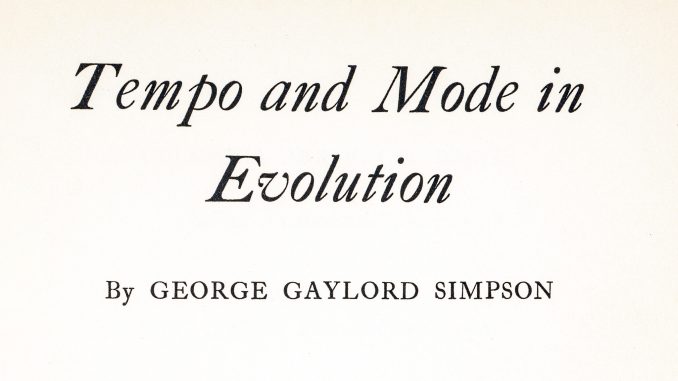
George Gaylord Simpson‘s (1902-1984) book, Tempo and Mode in Evolution, was published in 1944 by Columbia University Press in their Columbia Biological Series. This book played an important part in the expansion of evolutionary studies in post-WW2 America and Britain, commonly referred to as the synthesis period in evolutionary biology.
In August 2026, I posed a series of questions to the Generative AI software, Google Notebook LM (now Gemini Notebook), about the text itself. One feature of this LLM is the ability to largely restrict content knowledge to a user-defined library, though some leakage is notable. In this case, that library consisted solely of the single volume described here. The replies are reproduced in full here.
Audio summary
This LLM also has capacity to produce AI-generated voice “deep dives” into the source materials. These are structured to sound as if two humans are having a conversation or making a podcast episode about the material. The prompt is “Provide a robust summary without reference to any other sources. Discuss use of most frequently referenced authors. Focus on concepts relevant for biology students.”
Questions about Simpson (1944) Tempo and Mode in Evolution
Summarise the book in 400 words or fewer
George Gaylord Simpson’s Tempo and Mode in Evolution unites paleontological evidence with genetic theory to analyze the speeds (tempo) and patterns (mode) of evolutionary change.
Rates of Evolution (Tempo): Because direct genetic study is impossible for fossils, evolutionary rates are practically measured by morphological changes relative to a standard. Simpson identifies three distinct rate distributions in nature: horotelic (the standard or modal evolutionary rate typical of a given group), bradytelic (exceptionally slow evolution, allowing groups to survive practically unchanged for hundreds of millions of years), and tachytelic (exceptionally rapid, explosive evolutionary change).
Determinants of Evolution: Evolutionary tempo and mode are driven by variability, mutation rates, length of generations, population size, and natural selection. Population size is a crucial determinant; intermediate populations provide the best conditions for sustained evolution, whereas very small populations face random genetic fluctuations that can lead to either extinction or extremely rapid evolution. Natural selection acts as a truly creative force that dictates the intensity and direction of evolutionary change, acting to either concentrate, divide, or linearly shift populations.
Organism, Environment, and the Adaptive Grid: Evolutionary history is represented dynamically as an adaptive grid of ecological zones. Evolution relies on the continuous interaction between organisms and this grid, involving both preadaptation (traits incidentally fitting an available new environment) and postadaptation (the perfecting adjustment to it).
Modes of Evolution: Depending on how populations interact with the adaptive grid, evolution primarily follows three modes:
- Speciation: The local, subzonal differentiation of a widespread population, resulting in minor, shifting taxonomic distinctions.
- Phyletic Evolution: A sustained, directional shift of an entire population within a broad adaptive zone, which is typically responsible for the emergence of new genera and families.
- Quantum Evolution: A radical, interzonal leap by a small population from an unstable state to a distinctly new adaptive equilibrium. This rapid, all-or-nothing transition explains the often sudden appearance of higher taxonomic categories, such as classes and orders, in the fossil record.
Ultimately, Simpson argues that long-term evolution is not governed by mysterious internal momentum or predetermined straight lines, but by the continuous, dynamic interplay of selection, mutation, and shifting environmental opportunities.
Summarise each chapter in 200 words or fewer
Chapter I: Rates of Evolution
Chapter I explores how to measure evolutionary rates, defining them practically by the amount of morphological change relative to a standard, rather than by unmeasurable genetic changes in absolute time. Using examples like the Equidae (horses), Simpson demonstrates that related features, such as tooth height and overall size, can evolve at varying, independent rates. Evolutionary rates can be evaluated by studying individual characters, whole organisms, or larger taxonomic groups. By calculating the survivorship of fossil genera, Simpson reveals stark differences in average evolutionary speeds among different groups, such as the rapid evolution of land carnivores compared to the extremely slow evolution of bivalve mollusks. The chapter concludes that evolution rates fluctuate over time and across lineages, and that characters within a single lineage can undergo independent evolutionary acceleration or deceleration.
Chapter II: Determinants of Evolution
Chapter II analyzes the primary forces driving evolutionary rates and patterns: variability, mutation, generation length, population size, and natural selection. Simpson argues against the idea that evolution frequently proceeds through large, sudden jumps (“saltations”), asserting instead that continuous, small mutations are the standard material for evolutionary change. While generation lengths show surprisingly little correlation with evolutionary speed, population size is highly influential. Small populations are prone to rapid, random genetic fluctuations that can lead to swift, radical shifts or extinction, whereas intermediate-sized populations provide the optimal conditions for sustained, progressive evolution. Above all, natural selection acts as a truly creative vector. Rather than merely eliminating the unfit, selection dictates the direction of change—acting centripetally to specialize populations around an optimum, centrifugally to divide them, or linearly to shift them toward new adaptations.
Chapter III: Micro-Evolution, Macro-Evolution, and Mega-Evolution
Chapter III examines the scale of evolutionary changes, dividing them into micro-evolution (within populations), macro-evolution (forming species and genera), and mega-evolution (forming major groups like orders and classes). A persistent paleontological problem is the systematic absence of transitional fossils between major taxonomic groups, which some attribute to sudden, spontaneous leaps. Simpson argues that these gaps reflect the reality of the evolutionary process: mega-evolution typically occurs when a large population fragments into small, isolated lines undergoing intense environmental stress and selection. In these rare cases, a small population evolves at exceptionally rapid rates to cross a threshold into a radically new adaptive zone. Because these transitional populations are small, localized, and short-lived, their chances of leaving a fossil record are extraordinarily slim. Thus, major transitions follow the same genetic rules as minor ones but operate at accelerated speeds under unique ecological pressures.
Chapter IV: Low-Rate and High-Rate Lines
Chapter IV categorizes the varying speeds of evolution into three distinct rate distributions. Horotelic refers to the standard, modal rate of evolution typical for a given group. Tachytelic designates exceptionally rapid, transitional evolutionary bursts. Bradytelic lines are those that evolve at incredibly slow rates, surviving for hundreds of millions of years with negligible change, such as opossums or certain bivalves. Simpson notes that bradytelic animals are not inherently primitive; they were once rapidly evolving lines that achieved an excellent, broad adaptation to a continuously available and stable environment. Because they maintain large populations and their environment changes little, almost any new mutation is disadvantageous, causing selection to halt further evolutionary shifts. The chapter also introduces the “rule of the survival of the unspecialized,” observing that highly specialized branches often go extinct quickly, while broadly tolerant, less specialized parent stocks survive.
Chapter V: Inertia, Trend, and Momentum
Chapter V addresses the concepts of evolutionary “inertia” and “momentum,” particularly critiquing theories of orthogenesis which posit that evolution proceeds in straight lines driven by a predetermined or mysterious internal force. Using the detailed fossil record of horses, Simpson shows that evolution is rarely strictly rectilinear; it frequently branches, fluctuates, or reverses. Such linear trends that do exist are better explained by orthoselection—consistent natural selection steadily favoring a particular adaptive direction—combined with the naturally conservative limits of genetic inheritance. Simpson also thoroughly dismantles the theory of “evolutionary momentum,” which suggests that traits (like the saber-tooth cat’s fangs or the Irish elk’s antlers) can acquire a momentum that forces them to evolve past their optimal size, causing extinction. He argues instead that these supposedly lethal extremes were either perfectly optimal for a specific environment that suddenly shifted, or they were the secondary result of genetic linkages and relative growth rates.
Chapter VI: Organism and Environment
Chapter VI models the dynamic interaction between organisms and their environments, emphasizing that adaptation is the ultimate driver of evolutionary change. Simpson conceptualizes the ecological landscape as an adaptive grid composed of broad adaptive zones and narrower subzones. Evolution occurs as populations move within and across this grid. Successful occupation of a new zone requires that the zone exists, is empty or poorly defended by competitors, and that the organism is preadapted to survive there. Preadaptation and postadaptation are not opposing theories; rather, preadaptation allows an organism to cross into a new ecological zone, and postadaptation (via natural selection) perfects the organism for that specific environment. Therefore, evolution often appears step-like because species spend long periods expanding and adapting within a single zone, then occasionally make rapid, unstable leaps to conquer entirely new, vacant adaptive zones on the grid.
Chapter VII: Modes of Evolution
Chapter VII synthesizes the book’s concepts into three distinct modes of evolutionary change.
- Speciation is the local, subzonal differentiation of populations. It is characterized by minor, shifting, and sometimes reversible genetic adaptations to local niches, resulting in a branching, web-like pattern of closely related species.
- Phyletic Evolution involves the sustained, directional shift of an entire population within a broad adaptive zone. This is a long-term, strictly adaptive process driven by selection, and it typically results in the emergence of new genera and families.
- Quantum Evolution is the rapid, interzonal leap of a small population from an unstable state to a radically new adaptive equilibrium. This all-or-nothing reaction involves crossing an inadaptive threshold via preadaptation to reach a new major ecological zone. Though the transitional forms usually die out or leave no fossil record, quantum evolution is responsible for the sudden appearance of major taxonomic groups, such as distinct orders and classes.
What is “quantum evolution”?
Based on the provided text, George Gaylord Simpson defines quantum evolution as the relatively rapid shift of a biotic population from a state of disequilibrium to a completely new equilibrium that is distinctly unlike its ancestral condition.
He uses the term “quantum” because this mode of evolution typically acts as an all-or-none reaction. During this shift, subthreshold actions produce no stable reactions, while superthreshold actions produce a change of a definite magnitude. An evolutionary transition of this type must be completed rapidly; otherwise, the highly unstable population simply becomes extinct.
Simpson outlines several defining characteristics of quantum evolution:
- Interzonal Leaps: On the “adaptive grid,” quantum evolution is characterized by a radical, interzonal leap from one major adaptive zone to an entirely new one. The interval between the old and new equilibrium is a phase of extreme instability. Because populations cannot long survive in this intermediate state, they must either complete the shift to the new zone, revert back to their old state (which is exceedingly rare), or die out (the most common outcome). Consequently, transitional forms are virtually never preserved in the fossil record.
- Origin of Higher Taxa: While quantum evolution can occur at any taxonomic level, it is the most essential and dominant process responsible for the emergence of higher taxonomic categories, such as new families, orders, and classes.
- Three Distinct Phases: The quantum step is divided into three parts: (1) an inadaptive phase in which a group loses its ancestral equilibrium, (2) a preadaptive phase where extreme selection pressure rapidly drives the group toward a new ecological station, and (3) an adaptive phase where the population successfully achieves its new equilibrium.
- Small Populations and Rapid Rates: Quantum evolution typically takes place in small, completely isolated populations. These conditions allow for exceptionally rapid, or tachytelic, rates of change. In these small populations, environmental stress or random fixation of inadaptive mutations can cause a loss of equilibrium. If the group possesses a preadaptation for a new ecological zone, and if that new zone is physically open and free from heavy competition, the population will experience intense selection pressure to rapidly adapt to that new mode of life.
Identify the 6 most frequently referred to scientists in this work and their most cited works.
While George Gaylord Simpson frequently cites his own extensive paleontological research throughout the text, his analysis is built upon a continuous dialogue with the leading geneticists and paleontologists of his time.
Here are the six scientists most frequently referred to in this work, along with their most cited publications and their theoretical significance to Simpson’s arguments:
1. Sewall Wright
Wright is heavily cited for his foundational mathematical models of population genetics, particularly regarding how population size, mutation rates, and selection interact to drive evolution. Simpson relies on Wright’s models to explain how intermediate-sized populations are ideal for sustained evolution and how small populations are prone to random genetic drift and rapid “quantum evolution”.
- Most Cited Works: Evolution in Mendelian populations (1931) and The statistical consequences of Mendelian heredity in relation to speciation (1940).
2. Henry Fairfield Osborn
Osborn, a prominent paleontologist, is frequently referenced—and often critiqued—for his detailed fossil lineages and his theories on evolutionary momentum and “orthogenesis” (rectilinear evolution). While Simpson praises Osborn’s massive accumulation of factual evidence demonstrating that evolution occurs through small, continuous steps, he consistently rejects Osborn’s metaphysical concept of “aristogenesis” (the idea that an internal perfecting principle drives evolution).
- Most Cited Works: Aristogenesis, the creative principle in the origin of species (1934), and his extensive monographs The Titanotheres of Ancient Wyoming, Dakota and Nebraska (1929) and Proboscidea (1936, 1942).
3. W. D. Matthew
Matthew is a fellow paleontologist whose deep empirical knowledge Simpson uses to anchor arguments against saltation (evolution by sudden jumps). Simpson frequently uses Matthew’s detailed studies of mammalian evolution, particularly horses and carnivores, to demonstrate that apparent gaps in the fossil record are artifacts of sampling rather than evidence of spontaneous leaps. Simpson also utilizes Matthew’s attempts to estimate time ratios based on morphological evolution.
- Most Cited Works: Time ratios in the evolution of mammalian Phyla (1914), The phylogeny of the Felidae(1910), and The evolution of the horse (1926).
4. Richard Goldschmidt
Goldschmidt serves as Simpson’s primary theoretical adversary in the text. Goldschmidt argued for a strict dichotomy between “micro-evolution” (small adaptations) and “macro-evolution,” asserting that major taxonomic groups arise suddenly via radical chromosomal aberrations (“systemic mutations”). Simpson dedicates substantial portions of the text to dismantling this theory, arguing that there is no paleontological or genetic evidence for such sudden leaps, and that major transitions operate under the same neo-Darwinian rules as minor ones.
- Most Cited Works: The material basis of evolution (1940) and Physiological genetics (1938).
5. J. B. S. Haldane
Along with Sewall Wright and R. A. Fisher, Haldane is frequently cited for his mathematical theories of natural selection. Simpson utilizes Haldane’s estimates regarding gene frequencies, selection intensity, and random gene extinction. Haldane is also heavily referenced in Simpson’s discussion on evolutionary “momentum,” particularly his suggestions on how selection might favor juvenile traits that later become lethal in adults.
- Most Cited Works: The causes of evolution (1932) and New paths in genetics (1942).
6. Theodosius Dobzhansky
Dobzhansky is cited as a primary authority on modern experimental genetics, mutation rates, and the mechanisms of adaptation. Simpson references Dobzhansky to support the neo-Darwinian view that small, continuous mutations are the primary raw material of evolution, directly contrasting this with theories of large, sudden mutations.
- Most Cited Works: Genetics and the origin of species (1937, revised 1941) and Biological adaptation (1942).
Describe how Simpson uses research by the following people: Theodosius Dobzhansky, Julian Huxley, Ernst Mayr, Edgar Anderson, Alfred Emerson, and G. Ledyard Stebbins.
Theodosius Dobzhansky
Dobzhansky is one of the most frequently cited scientists in Tempo and Mode in Evolution, serving as George Gaylord Simpson’s primary authority on modern experimental genetics, mutation rates, and the mechanisms of adaptation. Simpson relies on Dobzhansky’s research to support several key arguments:
- Mutation Rates and Effects: Simpson uses Dobzhansky’s work to provide laboratory estimates of mutation rates and to reference mutation rates in wild populations. He also cites Dobzhansky to support the fact that most single genes have multiple (pleiotropic) or systemic effects on an organism’s structure.
- Neo-Darwinian Mechanisms: Dobzhansky is heavily cited to argue that small, continuous mutations—rather than massive, sudden leaps—are the primary raw material for evolution. For instance, Simpson references Dobzhansky’s interpretation of homoeotic mutants (like proboscipedia in fruit flies) as being entirely consistent with neo-Darwinian evolution. Simpson also uses Dobzhansky’s assertion that the accumulation of small mutations is the best-substantiated mechanism for rapid, or “quantum,” evolution.
- Chromosomal Aberrations: Dobzhansky’s studies on Drosophila are used to illustrate how closely related or indistinguishable species can have radically different chromosome arrangements, and how position effects from these rearrangements (like translocations and inversions) are analogous to gene mutations.
- Population Genetics: Simpson notes that Dobzhansky and Sewall Wright are actively correlating theoretical population genetics with observations of real wild populations. He also references Dobzhansky’s suggestion that low mutation rates might explain “bradytely” (exceptionally slow evolution), though Simpson himself is skeptical of this specific conclusion.
Julian Huxley
Huxley is used by Simpson specifically for his methods of analyzing relative growth (often called allometry or heterogony). Simpson relies on Huxley’s 1932 work to explain how the varying sizes of different structures in an organism are frequently determined by constant ratios of their growth rates, and how this genetic relationship can drive changes in proportions over evolutionary time. For example, Simpson uses Huxley’s demonstration of positive heterogony in the antlers of the deer Cervus elaphus to argue that the gigantic antlers of the extinct Irish elk were simply a mathematically linked consequence of the animal evolving a larger body size, rather than a lethal “momentum” effect.
Others
Ernst Mayr, Edgar Anderson, Alfred Emerson, and G. Ledyard Stebbins are not mentioned in the provided excerpts of Simpson’s Tempo and Mode in Evolution.
What are the five most cited items in this book?
1. R. A. Fisher, The Genetical Theory of Natural Selection (1930) This is the most frequently cited individual item in the text, with 7 explicit citations.
2. J. B. S. Haldane, The Causes of Evolution (1932) This item is the second most cited, appearing 6 times.
3. O. Abel, Paläobiologie und Stammesgeschichte (1929) This item ties for the third most cited work, appearing 5 times.
4. R. Goldschmidt, The Material Basis of Evolution (1940) This item also ties for the third most cited work, with 5 explicit citations.
5. Three-way tie (4 citations each) There is a tie for the fifth most cited item, as the following three works each appear exactly 4 times in the text:
O. M. B. Bulman, Programme Evolution in the Graptolites (1933) Simpson uses Bulman’s data on graptolites to illustrate periods of rapid species expansion followed by sharp declines. While Bulman found these declines inexplicable, Simpson reinterprets them as evidence of centrifugal selection, where inadaptive populations fragment and most become extinct. Simpson also references Bulman’s concept of “programme-evolution” regarding evolutionary trends and critiques his claim that orthogenesis caused monograptid extinction by carrying lobation to lethal extremes.
R. Pearl, Introduction to Medical Biometry and Statistics (1940) Simpson primarily uses Pearl’s statistical methodologies to construct and analyze modified survivorship curves for fossil genera. He cites Pearl’s humorous observation that automobile survivorship parallels that of cockroaches to warn that similar curve shapes do not imply similar evolutionary processes. Additionally, Simpson uses Pearl’s compiled coefficients of variation for human measurements to demonstrate that human physical variability is quite standard and matches that of many other mammals.
R. A. Stirton, Phylogeny of North American Equidae (1940) Simpson relies on Stirton’s modern classification to outline the successive genera in the Hyracotherium-Equus line, helping establish average evolutionary rates. He also cites Stirton’s data on the gradual appearance of a “small crochet” in Mesohippus cheek teeth to illustrate how small mutations slowly spread and segregate into distinct taxonomic traits. Finally, he references Stirton’s identification of multiple Merychippus phyla to exemplify multiple branching (polytomy) in evolution.
Which organisms does Simpson refer to most frequently? This could be species, genus, family, order, class, etc., or just generic groups.
Horses (Equidae) are the most extensively analyzed organisms in the text. Simpson uses the lineage from Hyracotherium (Eohippus) to Equus to illustrate a wide array of evolutionary principles, including rates of morphological change, the independent evolution of unit characters like tooth hypsodonty and foot mechanics, and the transition between browsing and grazing adaptive zones. He also frequently references the equid fossil record to critique the concept of “orthogenesis” (rectilinear evolution), demonstrating that horse evolution was branching and fluctuating rather than a single, predetermined straight line.
Pelecypods (Bivalve Mollusks) and Carnivores (Carnivora) are Simpson’s primary subjects for contrasting the evolutionary “group rates” and survivorship of entire orders. He relies on extensive data sets from these two groups to construct and compare survivorship curves, showing that carnivores evolve and go extinct much faster on average than pelecypods. Pelecypods, specifically genera like Ostrea and Nucula, are also his defining examples of “bradytely,” or exceptionally slow evolution.
Ammonites, particularly the genus Kosmoceras, are frequently cited to demonstrate correlative rates of evolution in invertebrates. Simpson heavily utilizes Brinkmann’s data on Kosmoceras to analyze how variation behaves in branching phylogenies and to prove that sudden morphological “saltations” in the fossil record are often just artifacts of missing sedimentary strata.
Drosophila (Fruit flies) serve as Simpson’s primary reference for laboratory genetics. He cites them frequently when comparing theoretical models of population survivorship, mutation rates, and genetic variation against the paleontological record.
Opossums and Crocodiles are repeatedly referenced as classic examples of “low-rate” or bradytelic lines. Simpson uses them to argue that groups can survive for tens of millions of years with relatively little change because they remain highly successful and perfectly adapted to a continuously available environment, rather than because they are “generalized” or primitive.
South American Ungulates (including notoungulates and litopterns) are his main examples of “explosive” evolution. He uses their history to illustrate how a small, obscure population can suddenly undergo “quantum evolution,” rapidly fanning out into multiple new, unoccupied adaptive zones.
Cats (Felidae), specifically the extinct sabertooths (machairodonts like Smilodon) and true felines, are used to illustrate shifts in the adaptive grid and to debunk the theory of evolutionary “momentum”. Simpson argues that sabertooths did not go extinct because their teeth grew past an optimal size due to momentum, but because the specific large herbivores they preyed upon died out.
What value is research on Drosophila for Simpson?
Drosophila serves as George Gaylord Simpson’s primary reference point for laboratory genetics and experimental data, providing a crucial testing ground to compare theoretical genetics against the actual paleontological fossil record. The research on Drosophila brings value to his work in several specific ways:
Evaluating the Nature of Mutations and Adaptation Simpson relies on Drosophila to explore how mutations behave in established populations. Because Drosophila is a highly specialized and well-adapted organism, he observes that the chances of any one new mutation being advantageous are incredibly low. He also cautions that the types of mutations most frequently studied in Drosophila—those producing large, well-marked, and discontinuous physical effects—are rarely observable in fossils and are likely the “least important for long-range evolution”. Additionally, Drosophilaexperiments on eye-color mutations (such as the high frequency of mutation to white) demonstrate that while mutations can be inherently directional, this direction is often completely random relative to the actual adaptive evolution of wild populations.
Dismantling Theories of Sudden Evolutionary Jumps Simpson extensively uses Drosophila genetics to counter the idea of “saltation”—specifically Richard Goldschmidt’s theory that major taxonomic groups arise suddenly via radical chromosomal changes or systemic mutations.
- Homoeosis: While homoeotic mutants in Drosophila (like tetraltera and proboscipedia) can produce physical traits belonging to entirely different families or orders of insects, Simpson argues this is merely an extreme phenotypic effect. A Drosophila with a Termitoxenia-like wing character is still fundamentally a Drosophila, and these mutations do not magically create a completely new genetic reaction system.
- Chromosome Arrangements: Simpson points out that visually similar species like D. pseudoobscura and D. miranda have radically different chromosome arrangements, whereas D. melanogaster and D. simulans have almost identical arrangements. This proves that radical chromosomal restructuring does not inherently produce sudden, major evolutionary transitions.
Modeling Survivorship and Evolutionary Rates Simpson uses statistical data on Drosophila to build analogies for evolutionary time scales. He compares the survivorship curves of mutant Drosophila individuals to the generic survivorship curves of pelecypods and carnivores. While noting that individual life spans are not perfectly homologous to the durations of entire genera, he uses the Drosophila curve to visually model a sort of “evolutionary metabolism”. Furthermore, he notes suggestions that Drosophila itself might have an abnormally low evolutionary rate, potentially serving as a modern parallel for slowly evolving, or “degenerative,” fossil lines.
Analyze the 30 most frequently used and conceptually dominant scientific words (nouns, verbs, adjectives, and adverbs) that define Simpson’s 1944 text and recur throughout the provided chapters.
An analysis of the 30 most frequently used and conceptually dominant scientific words—grouped as nouns, verbs, adjectives, and adverbs—reveals the core theoretical framework of George Gaylord Simpson’s Tempo and Mode in Evolution (1944).
1. Conceptually Dominant Nouns
- Tempo: Represents the speed or velocity of evolutionary changes within a lineage, which Simpson seeks to quantify using paleontological data.
- Mode: Refers to the patterns, styles, or methods of evolutionary changes, which Simpson classifies into three basic styles: speciation, phyletic evolution, and quantum evolution.
- Rate (or Rates): Defines the amount of morphological change relative to a standard, which serves as the practical proxy for genetic modification over time.
- Population: The genetically effective breeding group (symbolised as N), which Simpson identifies as the essential unit in evolution.
- Selection: Natural selection, which Simpson defines as a truly creative force (rather than just an eliminating one) that operates as centripetal, centrifugal, or linear vectors.
- Mutation: Spontaneous, haphazard genetic events that supply the baseline raw materials of evolution.
- Variability (or Variation): The capacity of individuals within an active interbreeding population to differ from one another.
- Equilibrium: The state of balance (genetic or adaptive) within a population, which is maintained in phyletic evolution but lost and restructured in quantum evolution.
- Adaptation: The universal (static or dynamic) adjustment of the organism to its environment, serving as the core of Simpson’s synthesis.
- Zone (or Zones): Adaptive zones, representing distinct modes of life or environmental complexes that organisms occupy or transition between.
- Phylum (or Phyla): Continuous lines of descent or lineages.
- Discontinuity: The gaps in the fossil record, separating species, genera, or higher taxonomic categories.
- Genus (or Genera): The primary taxonomic unit used to estimate fossil organism rates of evolution.
- Trend (or Trends): The directional evolutionary progression of phenotypic characters (both primary and secondary).
- Momentum: The hypothetical, controversial tendency of a lineage to evolve past its optimum adaptiveness to the point of disadvantage.
2. Conceptually Dominant Verbs
- Evolve: The process of undergoing genetic and phenotypic changes across successive generations.
- Adapt: The ongoing process of establishing structural or physiological correlations with a specific environment.
- Diverge: The branching of a single lineage into two or more distinct adaptive types.
- Survive: To persist through selection pressure and environmental shifts.
- Shift: To move or alter in position, such as shifting gene frequencies, environmental optima, or adaptive zones.
3. Conceptually Dominant Adjectives
- Adaptive: Possessing selective or reproductive value; characterizing changes that align with selection pressure.
- Genetic (or Genotypic): Pertaining to underlying chromosomal, genic, or population-level hereditary factors.
- Morphological (or Phenotypic): Relating to physical structure and form, which is the primary evidence available to the paleontologist.
- Phyletic: Relating to continuous, directional changes within single lines of descent.
- Quantum: Defining relatively rapid, all-or-none evolutionary transitions across adaptive zones.
- Preadaptive: Having prospective functions that make a population viable in a new environment before it is actually entered.
- Extinct: Lineages that have completely died out.
- Rectilinear: Characterizing approximately straight, undeviating evolutionary directions.
4. Conceptually Dominant Adverbs
- Rapidly: Occurring at a high rate of change, often associated with small populations or quantum shifts.
- Slowly: Occurring at a low rate of change, typically seen in bradytelic lines.