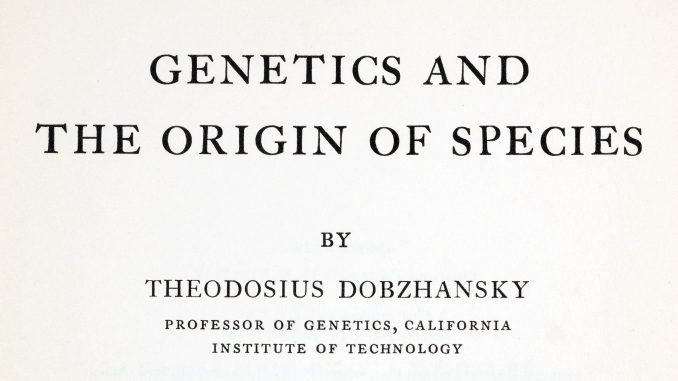
Theodosius Dobzhansky‘s (1900-1975) book, Genetics and the Origin of Species, was first published in 1937 by Columbia University Press in their Columbia Biological Series. This book played an important part in the expansion of evolutionary studies in post-WW2 America and Britain, commonly referred to as the synthesis period in evolutionary biology.
In August 2026, I posed a series of questions to the Generative AI software, Google Notebook LM (now Gemini Notebook), about the text itself. One feature of this LLM is the ability to largely restrict content knowledge to a user-defined library, though some leakage is notable. In this case, that library consisted solely of the single volume described here. The replies are reproduced in full here.
Audio summary
This LLM also has capacity to produce AI-generated voice “deep dives” into the source materials. These are structured to sound as if two humans are having a conversation or making a podcast episode about the material. The prompt is “Provide a robust summary without reference to any other sources. Discuss use of most frequently referenced authors. Focus on concepts relevant for biology students.”
Questions about Dobzhansky (1937)
Summarise Dobzhansky’s book in 400 words or fewer without reference to any other sources.
Theodosius Dobzhansky’s Genetics and the Origin of Species (1937) reconciles genetic science with evolutionary biology by defining evolution as a change in the genetic composition of populations. Confining his method to microevolutionary phenomena observable within a human lifetime, he demonstrates that these processes are sufficient to explain macroevolutionary diversity. He organizes evolution into three interacting levels:
1. The Origin of Variation: Heredity acts as a conservative force, which is counteracted by the constant, haphazard occurrence of gene mutations, chromosomal rearrangements (such as inversions and translocations), and polyploidy. These individual-level mutations provide the raw materials of evolution. Because Mendelian inheritance is particulate rather than blending, genetic variation is naturally preserved in populations rather than diluted over successive generations.
2. The Dynamics of Populations: Once injected into populations, genetic variants are molded by environmental forces. Relying on Sewall Wright’s mathematical models, Dobzhansky demonstrates that evolution is not driven by natural selection alone. In finite or small populations, random genetic drift—the “scattering of the variability”—can fix or eliminate traits purely by chance, allowing non-adaptive local races to form. The optimal condition for progressive evolution is a large species subdivided into semi-isolated colonies, which balances selection, mutation, and drift as populations explore the “adaptive peaks” of gene combinations.
3. The Fixation of Diversity: While geographical races are populations that merely differ in gene frequencies, speciation is the final stage of evolution where genetic discontinuity is fixed. Dobzhansky defines a species as the stage in the evolutionary process where an interbreeding community splits into separate lineages prevented from interbreeding by physiological “isolating mechanisms” (such as ecological barriers, sexual isolation, or hybrid sterility).
Additionally, Dobzhansky distinguishes between genic sterility (caused by complementary sterility genes, as inDrosophila pseudoobscura) and chromosomal sterility (caused by structural rearrangements). He also highlights polyploidy as a unique, cataclysmic method of rapid speciation resulting from hybridization, primarily in plants.
Ultimately, Dobzhansky demonstrates that organic discontinuity is maintained by physiological barriers that permanently preserve distinct, harmonious genotypic systems.
Summarise each chapter in 200 words or fewer referring only to Dobzhansky’s book.
Here is a summary of each chapter in Theodosius Dobzhansky’s Genetics and the Origin of Species (1937).
Chapter I: Organic Diversity
Dobzhansky defines organic diversity as a vast, discontinuous system of discrete, hierarchical arrays. To explain this, he proposes that evolution must be studied as a dynamic physiological process operating at three distinct levels:
- The origin of raw materials (mutations and chromosomal changes governed by individual physiology).
- The dynamics of populations (how selection, genetic drift, and geographic isolation mold genotypes).
- The fixation of diversity (physiological isolating mechanisms that prevent interbreeding and maintain discontinuity).
For biology students, bridging the gap between historical macroevolution and experimental microevolution is essential, as the same microevolutionary genetic forces observable within a human lifetime are responsible for driving long-term macroevolutionary change.
Chapter II: Gene Mutation
Heredity is fundamentally a conservative force, which is constantly counteracted by mutation, the ultimate source of all hereditary variation. Dobzhansky explains that mutations are spontaneous, haphazard events that affect only one chromosome of a diploid pair and alter individual gene structures. He emphasizes that:
- Mutations can alter any morphological or physiological trait.
- Seemingly minor “small mutations” are far more frequent and evolutionary important than drastic abnormalities.
- Most genes exhibit manifold (pleiotropic) effects, simultaneously affecting multiple structures and viability.
Although mutations are random, external agents like short-wave radiation can artificially increase mutation rates up to 200-fold.
Chapter III: Mutation as a Basis for Racial and Specific Differences
Dobzhansky seeks to prove that racial and specific differences are Mendelian in nature and originate through mutation. Experimental inbreeding reveals that wild populations, though outwardly uniform, are highly “infected” with hidden recessive and lethal mutations in heterozygous states. He demonstrates that geographic variation is driven by differences in gene frequencies. He explores maternal effects, where the phenotype of an organism (such as shell coiling in snails or hybrid testis size) is determined by the maternal cytoplasm. However, Dobzhansky clarifies that these cytoplasmic properties are ultimately controlled by nuclear genes present in the mother, keeping inheritance strictly genic.
Chapter IV: Chromosomal Changes
This chapter introduces the karyotype—the stable structural configuration of chromosome number, size, and gene arrangement. Dobzhansky classifies karyotypic modifications into numerical changes (like polyploidy) and structural rearrangements (deficiencies, duplications, translocations, and inversions). Because chromosomes require exactly one spindle attachment for meiotic survival, rearrangements are restricted. Dobzhansky demonstrates how overlapping inversions in wild populations of Drosophila pseudoobscura allow researchers to construct exact, unambiguous phylogenetic trees of chromosome descent. Finally, he explains position effects, proving that a gene’s physical location relative to its neighbors directly influences its development and phenotype, blurring the line between chromosomal changes and gene mutations.
Chapter V: Variation in Natural Populations
Dobzhansky contrasts particulate Mendelian inheritance with obsolete blending theories, showing that discrete genes prevent variability from being diluted or lost over generations. Under random mating, Hardy’s formula establishes a stable genetic equilibrium of gene frequencies. Populations act “like a sponge,” absorbing and storing mostly harmful recessive mutations in a concealed, heterozygous state to maintain evolutionary plasticity. Crucially, Dobzhansky integrates Sewall Wright’s models of genetic drift (the random “scattering of the variability”). In finite populations, random chance can fix or eliminate genes independently of selection. He concludes that a species subdivided into semi-isolated colonies of intermediate size provides the optimal conditions for race differentiation and evolutionary flexibility.
Chapter VI: Selection
Natural selection is a creative force that inevitably arises from the immense reproductive overproduction of organisms. Rather than acting on isolated genes, selection operates on entire gene constellations (genotypes) and their dynamic “reaction norms” to the environment. Dobzhansky reviews experimental evidence demonstrating selection in action under varying temperatures and densities. He highlights R.A. Fisher’s theory of the origin of dominance, which explains why most mutations are recessive: selection favors modifiers that make heterozygotes resemble the more viable wild-type. Importantly, selection is limited by population size. In Wright’s “adaptive landscape,” populations occupy “adaptive peaks”. The optimal condition for progressive evolution is a species divided into semi-isolated colonies, where the shifting balance of selection, mutation, and drift allows populations to explore and cross “valleys” to reach higher peaks.
Chapter VII: Polyploidy
While most speciation is a gradual process of genotype reconstruction, polyploidy (the multiplication of chromosome sets) represents a “cataclysmic,” rapid mode of species formation. Extremely common in plants but rare in animals, polyploidy is classified into:
- Autopolyploidy: The duplication of a single genome, which often reduces fertility due to meiotic pairing complications.
- Allopolyploidy: Chromosome doubling following hybridization between two distinct species, exemplified by the fertile Raphanobrassica hybrid of radish and cabbage.
Because each chromosome in an allopolyploid has an exact homologue, meiosis is regular, producing a true-breeding, sexually isolated, and highly successful new species without creating new genes. Polyploidy is also a valuable tool for cytologically tracing phylogenetic relationships.
Chapter VIII: Isolating Mechanisms
To prevent interbreeding from breaking down harmonious, adapted gene complexes into discordant recombinations, species must develop isolating mechanisms. Dobzhansky defines these as any geographical, ecological, or physiological barriers that prevent random gene exchange. While geographic isolation is a temporary external barrier, permanent speciation requires physiological isolating mechanisms. He classifies these into:
- Ecological or seasonal isolation (different habitats or breeding times).
- Sexual/psychological isolation (lack of mutual attraction).
- Mechanical isolation (mismatched reproductive organs).
- Hybrid inviability/developmental arrest.
These mechanisms usually originate as genetic by-products of divergence in geographically isolated populations. Once initial barriers develop, natural selection can actively strengthen them to prevent maladaptive hybridization.
Chapter IX: Hybrid Sterility
Hybrid sterility is one of the most critical physiological isolating mechanisms keeping species distinct. Dobzhansky makes a fundamental distinction between two types:
- Genic sterility: Caused by the developmental mismatch of complementary sterility genes contributed by the parents, which disrupts gonad development or meiotic divisions (e.g., reciprocal crosses in Drosophila pseudoobscura).
- Chromosomal sterility: Caused by structural chromosome differences that disrupt normal chromosome pairing, leading to unbalanced, inviable gametes with deficiencies and duplications.
Crucially, in genic sterility, chromosome doubling (polyploidy) does not restore pairing or fertility. In chromosomal sterility, polyploidy restores meiotic pairing and fertility because every chromosome gains an exact homologous partner. He also explains Haldane’s rule, where hybrid sterility or inviability primarily affects the heterogametic sex.
Chapter X: Species as Natural Units
Dobzhansky argues that species are objectively real, discrete natural units rather than arbitrary taxonomic conveniences. Discontinuity is maintained in the organic world because only a tiny fraction of the \(10^{1000}\) possible gene combinations is realized, with viable populations clustered around discrete “adaptive peaks”. Free interbreeding would destroy this structure, collapsing discontinuity into a continuous genetic blend. Consequently, Dobzhansky defines species as that stage of the evolutionary process at which the once interbreeding community of individuals becomes split into two or more distinct communities which are prevented from interbreeding by physiological isolating mechanisms. Because speciation is a gradual process of accumulating isolating mechanisms, transitional intermediate forms naturally exist. He notes that obligatorily asexual or self-fertilizing organisms do not fit this biological species concept but compensate by immediately fixing and testing favorable new genotypes.
Identify the 6 most frequently referred to scientists in this work and their most cited works.
Sewall Wright
Sewall Wright is prominently highlighted as the primary mathematical population geneticist who deduced the regularities of the evolutionary processes occurring in populations. He defined the “population number” (\(N\)) to refer strictly to the active breeding population rather than the total number of individuals of all ages. He calculated that in a finite population of \(N\) breeding individuals, a fraction of \(1/2N\) of the genes will either reach fixation or be lost in every generation. He formulated this progressive depletion of genetic variability mathematically as \(L_T = L_0 e^{-T/2N}\). Wright demonstrated that a species subdivided into semi-isolated colonies (demes) provides the most favorable balance of mutation, selection, and random genetic drift for progressive evolution.
Most Cited Works: “Evolution in Mendelian populations” (1931a) and “The roles of mutation, inbreeding, crossbreeding, and selection in evolution” (1932).
N. W. Timofeeff-Ressovsky
N. W. Timofeeff-Ressovsky is extensively referenced for his pioneering laboratory and observational genetics research. He conducted early experiments using X-rays to detect mutations affecting viability. He proved that wild fruit fly populations are highly “infected” with concealed recessive mutations. He also investigated the relative viability of geographical temperature races of Drosophila funebris under varying temperature and breeding conditions, showing that their viability is relative to the environment. Additionally, he discovered that geographic allelomorphs of the white gene (such as “Russian” and “American” alleles) exhibit distinct mutation rates and mutation directions when treated with identical X-ray radiation.
Most Cited Works: Publications on the experimental production of mutations (1934a, 1937) and studies on geographical temperature races of D. funebris (1935a).
A. H. Sturtevant
A. H. Sturtevant is credited as one of the geneticists who proved that every chromosome carries a definite complex of genes, and he founded the theory of the linear arrangement of genes within chromosomes. Alongside Dobzhansky, Sturtevant applied the “overlapping inversion method” to salivary gland chromosomes to construct exact, unambiguous phylogenetic trees tracing the historical descent of different chromosomal arrangements in Drosophila pseudoobscura. He also analyzed maternal effects in the water snail Limnaea peregra, demonstrating that the inheritance of shell coiling is determined by the genotype of the maternal parent.
Most Cited Works: Publications on the genetics of Drosophila simulans (1929a) and third chromosome inversions in wild populations (1936b).
H. J. Muller
H. J. Muller is highlighted as the pioneer who provided the first conclusive evidence that short-wave radiations, such as X-rays, artificially increase the frequency of spontaneous mutations up to 200-fold. He measured lethal mutation rates in the X-chromosome of Drosophila, illustrating how mutation rates are dependent on environmental temperature and time. He also demonstrated (with Settles) that the genes in animal spermatozoa are non-functional, meaning that spermatozoa can carry meiotically unbalanced chromosomes with gross deficiencies or duplications without losing their functional ability to fertilize zygotes.
Most Cited Works: “The problem of genic modification” (1928a) and “The measurement of gene mutation rate, its high variability, and its dependence upon temperature” (1928b).
N. P. Dubinin
N. P. Dubinin is heavily cited for empirical and theoretical work that bridges laboratory genetics with the study of wild populations. He published extensive surveys proving that wild populations of Drosophila melanogaster are heavily “infected” with hidden lethal and visible recessive mutations. Along with Romaschoff, he created a famous “bowl and marbles” experimental population model to illustrate how random genetic drift (scattering of variability) in small populations inevitably leads to complete homozygosis and genetic uniformity independent of selection. He also successfully reduced the number of chromosome pairs in Drosophila melanogaster from four down to either three or five pairs, and demonstrated (with Sidorov) the “position effect” of the hairy gene.
Most Cited Works: “Die genetische Struktur der Art und ihre Evolution” (with Romaschoff, 1932) and experimental studies on Drosophila ecogenotypes (1934).
R. A. Fisher
R. A. Fisher is cited as a major architect of mathematical population genetics. He provided a key mathematical argument showing that “small mutations” with minor phenotypic effects are far more likely to play a role in progressive evolution than mutations with gross effects. He formulated mathematical calculations showing the probability of a new mutation surviving or going extinct and established the rate of gene frequency changes under natural selection. Most famously, Fisher proposed the selective theory of the “origin of dominance,” arguing that natural selection favors modifying genes that suppress the unfavorable heterozygous effects of recurring mutations, eventually making them recessive.
Most Cited Work: “The Genetical Theory of Natural Selection” (1930).
What are the five most cited items in this book?
While the text does not contain a complete index tallying every single footnote, it reveals the five specific publications that Dobzhansky relies on most heavily to build his theoretical framework:
1. Sewall Wright, Evolution in Mendelian Populations (1931a)
Dobzhansky relies on Sewall Wright’s mathematical equations and theoretical concepts to explain population genetics. Wright’s calculations of the “effective breeding population” (\(N\)) and the rate at which genes are fixed or lost by chance (\(1/2N\) per generation) form the cornerstone of Dobzhansky’s chapters on population variation and selection. Dobzhansky also champions Wright’s shifting balance theory, which states that a large species subdivided into semi-isolated colonies provides the optimal environment for progressive evolution.
2. Ronald A. Fisher, The Genetical Theory of Natural Selection (1930)
Fisher’s work is cited as the primary authority for the particulate theory of inheritance, which proves that discrete Mendelian genes preserve hereditary variation instead of blending and diluting it over generations. Dobzhansky cites Fisher’s mathematical tables showing the high probability of a mutation’s extinction in early generations. Additionally, Fisher’s selectionist theory on the “origin of dominance” is cited extensively in Chapter VI to explain why most recurring mutations in wild populations are recessive to the wild-type.
3. N. P. Dubinin and D. D. Romaschoff, Die genetische Struktur der Art und ihre Evolution (1932)
This study is cited as the definitive experimental model for random genetic drift (or the “scattering of the variability”). Dobzhansky explains their famous “bowl and marbles” experiment to demonstrate how random mating in finite populations inevitably eliminates some alleles while doubling the frequency of others, eventually driving a population to complete genetic uniformity in the absence of selection.
4. H. E. Crampton, Studies on the Variation, Distribution, and Evolution of the Genus Partula(1916, 1932)
Crampton’s exhaustive field surveys of the land snails on the islands of Tahiti and Moorea provide Dobzhansky with his premier empirical example of geographic isolation in nature. He cites Crampton’s exact data on the varying frequencies of dextral and sinistral shell spirals in isolated valleys to show how physical barriers partition a species into distinct, non-adaptive “microgeographic races”.
5. H. J. Muller, The Problem of Genic Modification and The Measurement of Gene Mutation Rate(1928a, 1928b)
Muller’s pioneering works are cited as the conclusive proof that short-wave radiation (such as X-rays) artificially accelerates the spontaneous mutation rate of genes up to 200-fold. Dobzhansky cites Muller’s research on the temperature-dependence of mutation rates to establish baseline estimates for “mutation pressure” and uses Muller’s chromosomal studies to demonstrate that chromosomes are the physical, linear carriers of genes.
What value is research on Drosophila in Dobzhansky’s 1937 book?
For Theodosius Dobzhansky, research on Drosophila serves as the indispensable empirical bridge connecting laboratory-derived genetic laws with the evolutionary dynamics of wild populations. Because of its rapid development and unmatched suitability for experimental breeding, Drosophila is the primary organism in which geneticists have learned to control, predict, and synthesize hereditary types.
In Genetics and the Origin of Species, Dobzhansky utilizes Drosophila research to substantiate virtually every major level of his microevolutionary synthesis:
1. Proving the Presence of Evolutionary Raw Materials in Nature
A major historical challenge was proving that the mutations observed in laboratories actually occur in the wild. Dobzhansky highlights systematic surveys of wild Drosophila melanogaster (by Tschetwerikoff, Timofeeff-Ressovsky, and Dubinin) and D. pseudoobscura (by Sturtevant) showing that natural populations, though outwardly uniform, are heavily “infected” with hidden recessive mutations and lethals in heterozygous states. This provided concrete proof that the raw materials of evolution are continuously accumulating in natural populations.
2. Redefining Mutation, Viability, and Dominance
Drosophila research shattered early misconceptions that mutations only produce superficial abnormalities or “monstrosities”:
- The Viability Spectrum: Research by Timofeeff-Ressovsky on D. funebris demonstrated that the viability of a mutation is not an absolute defect but a dynamic function of both the environment (e.g., temperature) and the rest of the genetic background.
- Quantitative Mutation Rates: Precise measurements of lethal mutation rates in the X chromosome of D. melanogaster (using Muller’s CIB method) provided the first quantitative estimates of “mutation pressure”.
- Manifold Effects: Drosophila mutants like white, vestigial, and stubbloid proved that genes have pleiotropic (manifold) effects, simultaneously affecting prominent external traits (like eyes or wings) and vital internal physiology (such as the shape of the spermatheca). This warned taxonomists that seemingly “neutral” systematic traits might actually be linked to vital physiological adaptations.
- The Origin of Dominance: Extensive multiple allelomorphic series (such as the white eye-color locus) provided empirical evidence for Fisher’s and Wright’s theories of the evolution of dominance, showing how natural selection shapes the heterozygous expression of recurring mutations.
3. Tracing Karyotypic Evolution and Phylogeny
The introduction of the giant salivary gland chromosome technique by Painter (1934) transformed cytology into a precise evolutionary tool. In the salivary glands of larval flies, chromosomes are highly enlarged and exhibit constant, specific banding patterns:
- Overlapping Inversions: Using wild populations of D. pseudoobscura, Sturtevant and Dobzhansky applied the “overlapping inversion method”. Because a chromosome must undergo a specific sequence of inversions to transition from one arrangement to another, this method allowed researchers to construct exact, unambiguous phylogenetic trees of chromosomal descent.
- Repeats and Gene Duplication: Bridges’ discovery of “repeats” (homologous, duplicate chromosome sections) in D. melanogaster provided a plausible physical mechanism for how a species can duplicate its genetic material and gradually evolve entirely new genes.
- Delineating Interspecific Rebuilding: Direct cytological comparison between closely related species—such as the highly similar D. melanogaster and D. simulans, or the profoundly rearranged D. pseudoobscura and D. miranda (which differ by a minimum of 49 chromosomal breakages)—revealed exactly how chromosomes are dismantled and reconstructed during speciation.
4. Demonstrating the “Position Effect”
Drosophila provided the premier evidence for the position effect—the discovery that a gene’s physical location relative to its neighbors directly alters its phenotypic expression. This was demonstrated through Sturtevant’s work with the Barand double-Bar duplications and Dubinin and Sidorov’s experiments with translocations at the hairy locus. This blurred the traditional boundary between gene mutations and structural rearrangements, showing that rearranging chromosome segments can act as an active evolutionary agent.
5. Demystifying the Mechanisms of Speciation and Hybrid Sterility
The biological definition of a species relies on physiological barriers to interbreeding, and Drosophila was the ideal genus to dissect these isolating mechanisms:
- Sexual Isolation: Quantitative mating choice experiments (by Boche and Dobzhansky) in D. pseudoobscura and D. miranda proved that populations exhibit clear mating preferences, which natural selection can actively strengthen where species overlap.
- Genic Sterility in Interracial Hybrids: Lancefield’s discovery of the sterile male but fertile female hybrids of D. pseudoobscura Races A and B allowed Dobzhansky to map the exact genetic causes of sterility. By crossing marked chromosomes, he proved that hybrid sterility is not caused by maternal cytoplasm or meiotic pairing failures, but by a cumulative, complementary system of at least eight “genic sterility” factors distributed across the autosomes and X chromosomes.
- Decoupling Gonad and Somatic Sterility: Dobzhansky and Beadle’s testis transplantation experiments in D. pseudoobscura proved that hybrid sterility operates autonomously within the gonad itself rather than through interactions with the surrounding somatic tissues.
- Explaining the Rarity of Animal Polyploidy: Bridges’ genic balance theory of sex determination in D. melanogaster (where sex is determined by the ratio of X chromosomes to sets of autosomes) mathematically explained why polyploidy, while highly successful in the plant kingdom, is exceptionally rare in animals due to meiotic and sex-determining complications (which produce sterile intersexes).
Which organisms does Dobzhansky refer to most frequently (exclude Drosophila)? This could be species, genus, family, order, class, etc., or just generic groups.
Excluding his extensive references to Drosophila, Dobzhansky draws upon a wide variety of botanical and zoological organisms in his 1937 work to illustrate the core concepts of the modern evolutionary synthesis.
Based on the provided excerpts, the non-Drosophila organisms referred to most frequently and used as primary experimental or field models include:
1. Plants
- Tobacco (Nicotiana): Tobacco plants are referred to extensively in discussions of species hybridization, polyploidy, and genome analysis. Dobzhansky details the synthesis of the fertile allohexaploid Nicotiana diglutafrom the cross of N. tabacum and N. glutinosa, and uses other species like N. rustica, N. sylvestris, and N. glaucato demonstrate genic compatibility and barriers.
- Wheat (Triticum) and Aegilops: These genera are heavily referenced to explain the evolution of polyploid series. Dobzhansky outlines how the basic chromosome sets (A, B, and D) differentiate the diploid einkorn, tetraploid emmer, and hexaploid vulgare (soft) wheats, demonstrating how hybridization and chromosome doubling lead to speciation.
- Jimson Weed (Datura stramonium): Relying on Blakeslee’s research, Datura is used as a classic model for karyotypic mutations, showing how haploid individuals produce diploid offspring, and how translocations create meiotic chromosome rings or “prime types”.
- Radish (Raphanus) and Cabbage (Brassica): Karpechenko’s creation of the synthetic allotetraploid hybrid Raphanobrassica is Dobzhansky’s premier example of how chromosome doubling in a sterile diploid hybrid can restore meiotic pairing, regularize gametogenesis, and establish a sexually isolated, fertile new species.
- Hawk’s-beards (Crepis): This genus is used for comparing metaphase chromosome plates. Dobzhansky also highlights Crepis tectorum crossed with C. capillaris to illustrate how a single gene in “statu nascendi” can act as a lethal factor in interspecific hybrids.
- Snapdragons (Antirrhinum): Relying on Baur’s work, snapdragon species crosses (such as A. majus X A. molle) are cited repeatedly to demonstrate how complex Mendelian segregations in the second generation yield a boundless, polymorphic “riot” of new recombinations and forms.
2. Invertebrates
- Land Snails of the Genus Partula: Relying on Crampton’s exhaustive field data on the snails of Tahiti and Moorea (such as Partula suturalis and P. taeniata), Dobzhansky uses these organisms as his premier empirical example of “microgeographic races”. He highlights the frequencies of dextral and sinistral shell-coiling in isolated valleys to show how non-adaptive geographic variation can be maintained.
- Ladybird Beetles (Coccinellidae): Dobzhansky frequently draws upon his own entomological expertise, highlighting the Asiatic lady beetle Harmonia axyridis to explain discontinuous geographic variations in elytral color patterns and Coccinella septempunctata to explain continuous variations in spot sizes. He also cites Epilachna chrysomelina to demonstrate how embryonic development can be arrested in crosses between different geographic races.
- Moths, particularly the Gypsy Moth (Lymantria dispar) and Pygaera: The gypsy moth is used to illustrate continuous geographic variation governed by multiple genes (Goldschmidt’s work) and meiotic sex-determination systems. Species of Pygaera and Saturnia are extensively referenced in the analysis of hybrid sterility to demonstrate meiotic pairing failures where chromosomes remain univalent.
3. Vertebrates
- Deer Mice of the Genus Peromyscus: Relying on Sumner’s and Dice’s studies, Dobzhansky uses these mice as a major mammalian model to show the inheritance of quantitative pelage traits in crosses and to explain how ecological isolation (such as forest vs. prairie or beach habitats) keeps overlapping subspecies from interbreeding in nature.
- Humans (Homo sapiens): Man is primarily referenced to demonstrate the geographical variability of traits governed by multiple alleles, such as the global distribution and varying frequencies of blood groups.
Analyze the 30 most frequently used and conceptually dominant scientific words (nouns, verbs, adjectives, and adverbs) that define Dobzhansky’s text and recur throughout the provided chapters.
Here is an analysis of the 30 most frequently used and conceptually dominant scientific words (nouns, verbs, adjectives, and adverbs) that define Dobzhansky’s text and recur throughout the provided chapters.
1. Core Biological Units & Categories (Nouns)
- Species: The central taxonomic and evolutionary unit of the book, which Dobzhansky defines as the stage in evolution where an interbreeding community splits into distinct lineages prevented from interbreeding by physiological barriers.
- Gene: The fundamental particulate unit of heredity. Dobzhansky focuses on gene mutations, gene frequencies, and genic sterility.
- Chromosome: The physical, linear carrier of genes. He focuses heavily on salivary gland chromosomes and chromosomal rearrangements.
- Population: The active breeding unit. Dobzhansky defines evolution as a change in the genetic composition of populations over time.
- Race: Subdivisions of species (geographic, ecological, or microgeographic) that differ in their relative gene frequencies.
- Organism: The living individual expressing the genotype; Dobzhansky examines how mutations affect an organism’s development and viability.
- Hybrid: The offspring of crosses between different species or races, studied extensively to understand meiotic pairing and sterility.
- Type: Recurring frequently in terms of the “wild-type” (ancestral form), “prime types” (chromosomal configurations in Datura), and “karyotypes”.
- Form (or Forms): Used to describe physical variations, geographic forms, and the massive segregation of new morphological combinations in hybrid offspring.
2. Evolutionary Forces & Processes (Nouns & Verbs)
- Mutation: The primary variation-producing agent that alters individual gene structures and provides the raw material for evolution.
- Selection: Natural selection, which Dobzhansky treats as a creative, directional force acting on entire genotypes rather than isolated genes.
- Isolation: The barrier to interbreeding—both geographic (external) and physiological (genetic)—which is aconditio sine qua non for speciation.
- Variation (or Variability): The differences within and between populations. Dobzhansky notes that populations act as “sponges,” absorbing and storing this variability in a heterozygous state.
- Sterility: A critical physiological isolating mechanism, categorized into genic sterility (caused by complementary genes) and chromosomal sterility.
- Evolution: The long-term historical consequence of mutation, selection, and isolation acting on natural populations.
- Pairing (or Pair): The crucial meiotic alignment of homologous chromosomes, which fails during chromosomal hybrid sterility.
- Rearrangement: Gross structural modifications of chromosomes (such as translocations and inversions) that alter gene configurations.
- Crossing (or Cross): Both the genetic exchange of segments (crossing over) and the experimental breeding of different strains or species.
- Change: Referring to both gene mutations and structural chromosomal alterations that drive genetic drift and selection.
3. Descriptive & Structural Terms (Adjectives & Adverbs)
- Genetic: Pertaining to heredity, genetic drift, genetic structure, and the genetic equilibrium modeled by Hardy’s formula.
- Different: Constantly used to contrast different species, different populations, and different environmental conditions.
- Natural: Referring to natural selection, natural units (species), and the genetic composition of wild, natural populations.
- Geographical (or Geographic): Defining the physical distribution of races, geographical isolation, and rules of geographic variation (such as Bergmann’s and Gloger’s rules).
- Wild: Referring specifically to “wild populations” or “wild-type” alleles, proving that laboratory-style mutations occur out-of-doors.
- Structural: Used to describe structural chromosomal aberrations (inversions, translocations, deficiencies) as opposed to numerical changes.
- Physiological: Referring to internal, developmental properties, such as physiological isolating mechanisms and physiological traits affected by pleiotropic genes.
- Polyploid (or Polyploidy): The duplication of chromosome sets, representing a unique, rapid mode of speciation primarily in plants.
- Discontinuous (or Discontinuously): Describing the gaps in organic variation that separate species and prevent a perfect continuum of forms in nature.
- Harmful: Frequently referenced alongside “unfavorable” and “lethal” to describe the typical, recessive mutational effects that build up in heterozygous states.
- Frequently (or Haphazardly): The primary adverbs used to describe how mutations arise spontaneously and without direction in populations.