
Students ask for letters of reference and recommendation. Writing them is an important responsibility for tutors. It’s something we take extremely seriously. But what goes into a letter of recommendation?
Top Tips When Requesting References
Let’s cut to the chase. Here are some top tips for improving the references produced for you:
- time – give me time to think and to write. Letter writing is work. It’s extra work. It’s work that has to be done in addition to everything else. I need to delay something else to do this work you are asking me to do. Give me as much time as possible. Don’t ask me to do it over holidays. Don’t ask me to do it on 24 or 48 hours notice.
- information – give me information I can use. You likely have drafted a personal statement for your application. You have a CV. You have sample coursework (material you’ve produced for courses that you’re proud of and you think stand as good examples of you working hard and intelligently). I can look up your grades.
- ambition – tell me your ambitions. Why are you seeking the opportunity you’re applying for? Is it a passion? Is it an exploit? Is it the next step on the long march to a career? This helps me consider how I can relate what I know to what you propose to do. It helps me use my judgment for how best to recommend you.
- attention – give me your attention. Office hours and in-person drop-in times are offered specifically so students can visit for informal conversation about their academic programme. Use that time effectively to discuss your ambition and information. Use that time to develop rapport with me.
- respect – give me some respect and show some respect for the process. If you’re asking for 12 letters of reference, stop and see that request from my point of view: you have no idea what you want to do or where to go; you have made little effort to prioritise; you don’t care where this is going; you don’t care about my time or the value of me as a resource. Your generic approach is likely to result in me producing a generic letter for you. Is that going to improve your competitiveness? (Spoiler: no.)
- gifts – please do not bring gifts when asking for a reference. This is a common custom in some communities, and it’s generous of you to consider it. Gift giving also is a common way for nervous students to buffer their requests for a reference. Gift-giving is entirely unnecessary. Referencing is part of the student-tutor relationship, and I expect you to need letters of recommendation from someone at some point. I would much rather you come prepared for your conversation with the elements described above than with a gift. Being prepared is an important sign of professional respect, and it is something that is notable in recommendations.
Do I Complete a Form?
Increasingly, university recommendation systems provide tick boxes for summary assessments. This example is from Hong Kong University (HKU) (2026).
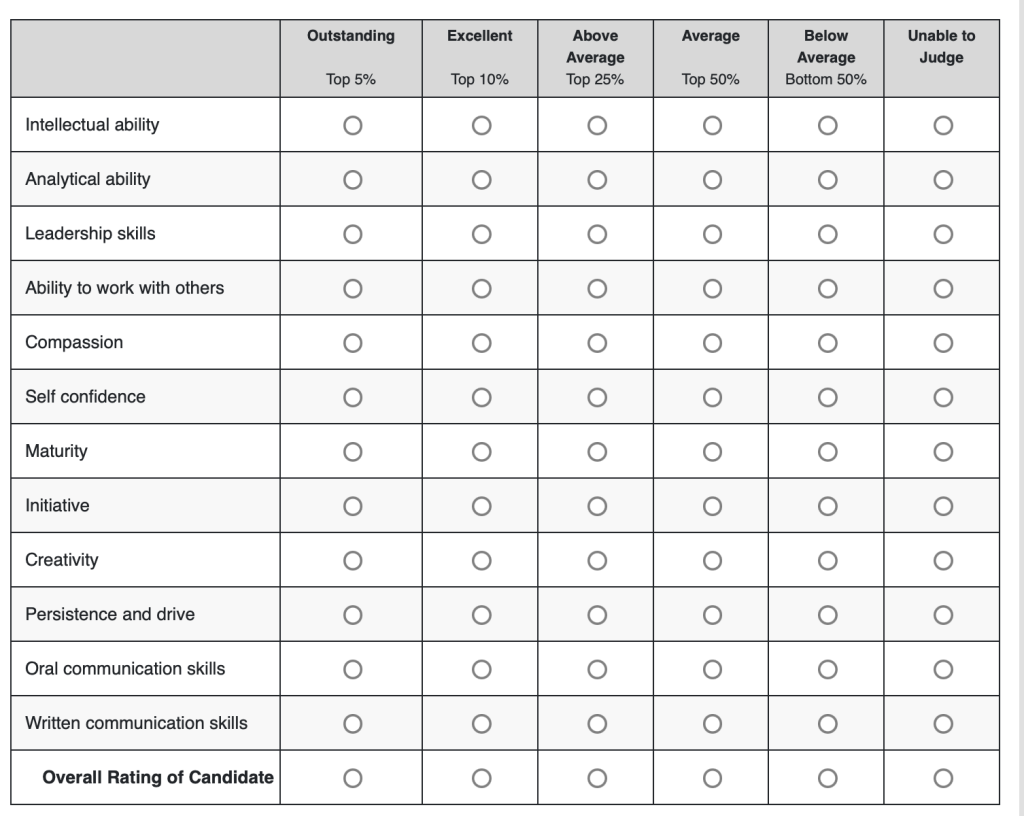
Take away from this list a set of questions for yourself: how do you demonstrate “initiative”? Or “persistence”? What do I know about you on these points when what I see with my own two eyes is you sitting a classroom passively tapping into a laptop, maybe or maybe not engaged with the material? What can you do to rise above the average student in my observations either in class or in other opportunities?
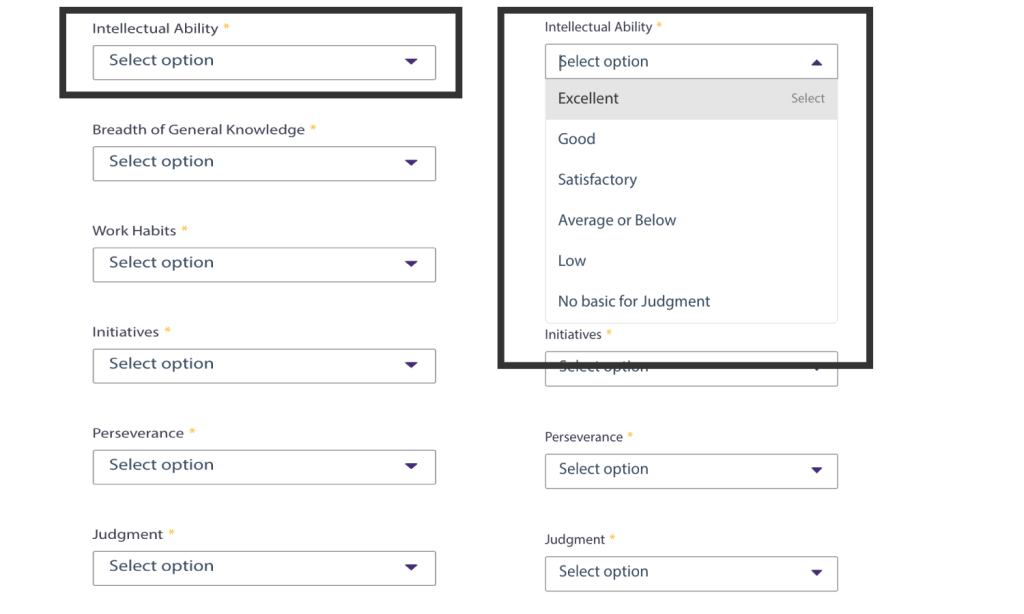
These tables oversimplify the process of writing a reference. The range of responses decreases. The room for additional comment, nuance, and qualification is reducing, too. Ask yourself how can you plan to be clearly and unambiguously scoring in the top option of these qualities. They systems don’t give a lot of room to work.
Other Guidance to Referees
Sometimes universities want more information. They often give referees guidance on what they are looking for in the recommendation. Again, ask yourself how you are demonstrating these qualities for the people writing your references. You might be phenomenally well organised in most aspects of your life. But what do your tutors observe? How are you drawing them into a better understanding about you?
This is an example of instructions provided from a Russell Group university in the UK.
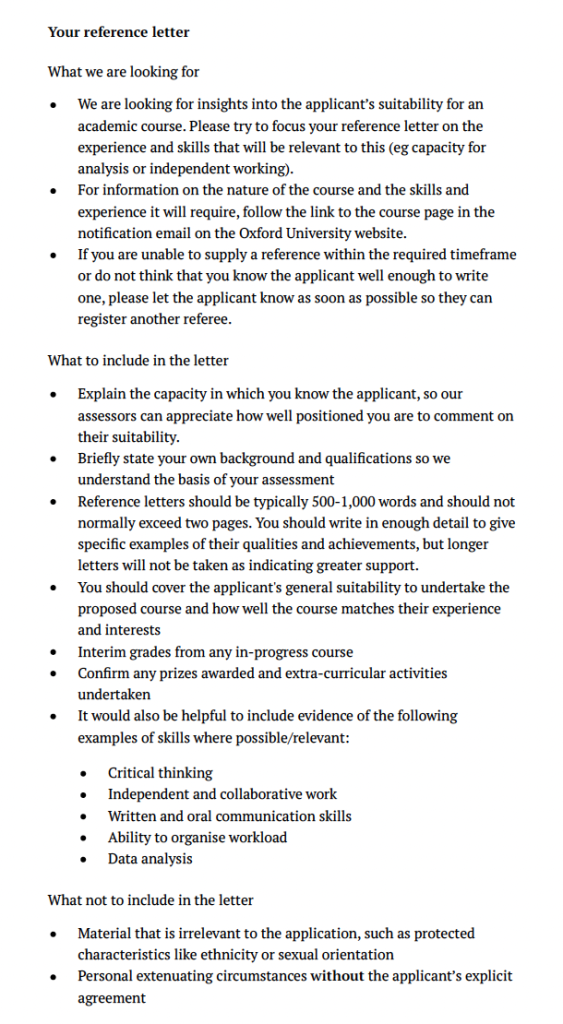
Focus on the section “It would also be helpful to include evidence of the following examples of skills where possible/relevant”. The question for you is how you can demonstrate these features for your referees.
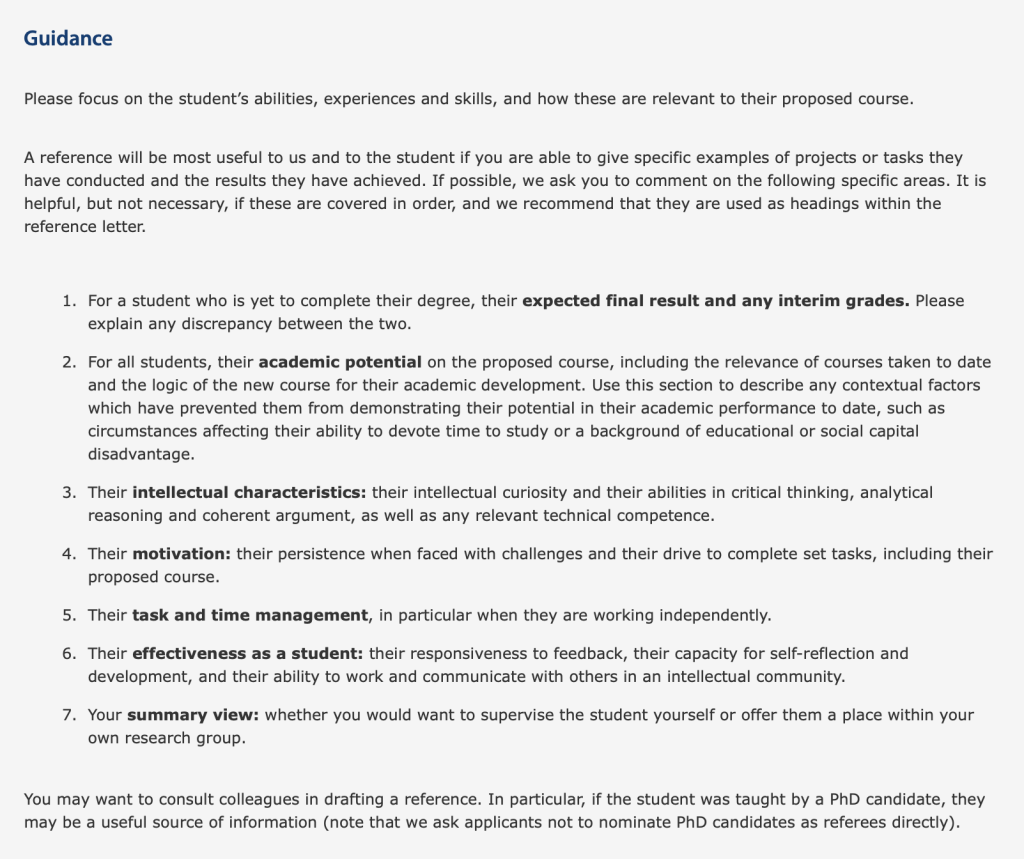
This is another instruction to referees for an academic letter of reference.
The Reference I Don’t Want to Write
The worst reference I write is something like this:
“This person asked me to write a reference. I taught them in one module. They received a mark of 52. I have no other information about them. They did not discuss their application with me.”
When I see a letter like this, I think “reject this application”.
The reasons for this scale of detachment should be obvious. The student utterly failed to distinguish themself in the class or during their studies. More important, the student failed to prepare me to write a reference for them. The student chose their referee poorly.
Time to Make a Change
Students worry about jobs and further degrees. You are right to worry. But there is a lot you can do to prepare.
UCL Career Service offers a wide range of activities specifically for you.
You have an Academic Tutor, too. You should visit them at least once each term. They’ll welcome you for more provided you use their time constructively. Take the initiative to visit them in their drop-in hours and by appointment. They are ideally situated to speak about your overall academic experience and performance. They should not be strangers by the time you complete your degree; in fact, you should develop them as a resource for you both as a mentor and as a referee.
Who Writes the Best Recommendation?
A person who knows you well writes the best recommendation.
In STS, Academic Tutors are the default choice for you. By “default” I mean that this is a person you can approach for a recommendation if you don’t know who else to approach. If I’m your academic tutor, I will be following your academic progress through your degree. You will have met with me at least a few times. You might say, I am assigned with the task of monitoring your performance so I can write a letter of recommendation at some point in your future. This is a minimum standard for a referee. You can do a lot better than that. You should do a lot better than this. But if you have nowhere else to turn, turn to your Academic Tutor.
It’s your choice whether you put effort into developing rapport with your Academic Tutor or you do this with other people. But be sure you’re cultivating someone to act as a knowledgeable referee. They can be a valuable asset in the years to come.