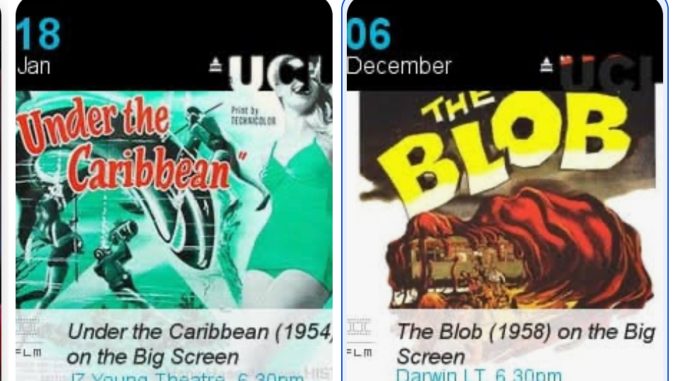
For about 10 years, I was part of a collaborative project, “Film Night at the Grant Museum”. Partners included Jack Ashby, Mark Carnall, and Dean Veall. Jack promoted the films as “On the Big Screen” events. Each quarter, we presented a film with some sort of vague connections to history of natural history and public engagement with life sciences. This was a free event. Films were selected as classics in the subject and as ones we thought deserved wider public discussion. One of my own goals for the series was to energise interest in film watching towards active viewing and in-person conversation.
Structure
The event structure stayed fairly consistent over the years. Lots of work went into marketing and promotion. The evening began with a welcome from the Grant Museum as our host. Next, I gave 10ish-minute introductions to each film. These mostly focused on things the audience might look for in the film: particular action, trivia, and notable connections. I also added a “film studies moment” when I dropped in an academic concept or film studies 101 idea for audience members to ponder while watching the film. I also thought it always important to explain the etiquette for the event: audience members were encouraged to engage as the film progressed: laugh, applaud, boo and hiss, react, and more. With very few exceptions, contributions came in the spirit of camaraderie and friendliness. Much comment was disseminated via social media, too. Normally, we’d run the film without an interval. Afterwards, the audience was invited to the Museum to enjoy their exhibits (possibly for the first time) and to continue talking about the film over refreshments. We wanted friendly entertainment to nudge attendees toward our educational ambitions.
Knowing the comfort-level of our seating, we kept a keen eye on running times and pace. We also kept an eye on taste and decency. I refused to include in the series quite a few films I otherwise would have liked to discuss simply because I thought them beyond the pale for one reason or another. For the few I relented on, I felt I was honest with audiences about why and why we should expect better of ourselves. I didn’t think it was good enough to say that a film was “of its time”, then ignore the queasiness or stigmatisation.
Timing was important, too. Some audience members wanted a lot more film nights. We kept at a slow and steady pace – I think it was one per quarter – because this was part of a much larger public engagement strategy, with many moving parts. (The Grant Museum had a particularly strong public engagement programme in that period, before management screwed it up in what I felt was a highly suspicious reorganisation.) It also was because we did not want to dilute the film programme. We wanted this to be something people looked forward to.
Trivia
As an example of trivia, this is one of my favourites. Consider the famous closing line in King Kong (1933), “Oh no, it wasn’t the airplanes. It was beauty killed the beast.”
In the credits at the end of the film, this line is sourced to an “old Arabian proverb”,
“And the prophet said: ‘And lo, the beast looked upon the face of beauty. And it stayed its hand from killing. And from that day, it was as one dead.’
— Old Arabian Proverb”
This “proverb” is utterly fictional. It was invented by scriptwriters to create an exotic context for male behaviour. Don’t believe a word of it.
To me, it wasn’t beauty that killed the beast. It was extractive businessmen (who took Kong from the island and immediately put him on show) and a shoot-first strategy of suppression (once up the Empire State Building, surely there was time and space to cool down everyone’s panic). But I suppose the film was unlikely to end with Carl Denham saying, “I guess this was all my fault. It was greed that killed the beast.”
Audience
All public engagement begins with audience. Film Nights were intended to reach several groups. First, it was the early professional groups in London. This was the 24-35 working community in London who might meet after work for drinks and an easy social event. They might have been to university, but after a first degree, they moved into work. Film Nights used the university to validate attendance, just as a gallery or museum platform might. Film Night was rarely date night. Most commonly, mates night.
The second group in our intended audience consisted of what the industry sometimes calls “silver screeners”: older, usually retired, members of our communities. Most were living on limited budgets and relatively low levels of social interaction elsewhere in their lives. They already were a devoted component of the Grant Museum’s audience, and some became intensely loyal participants in the series. Frequently, they had seen these films when younger and had followed stories about actors, storylines, and surrounding cultures of these films for much of their lives. Once in a while, someone would bring in a treasured piece of memorabilia or share a personal connection with a film. Through these I saw how engagement programmes like these don’t “give back” so much as “warms the cockles” of treasured memories and associations.
We did not target students, and their numbers never really amounted to much of a fraction in the room.
Hats
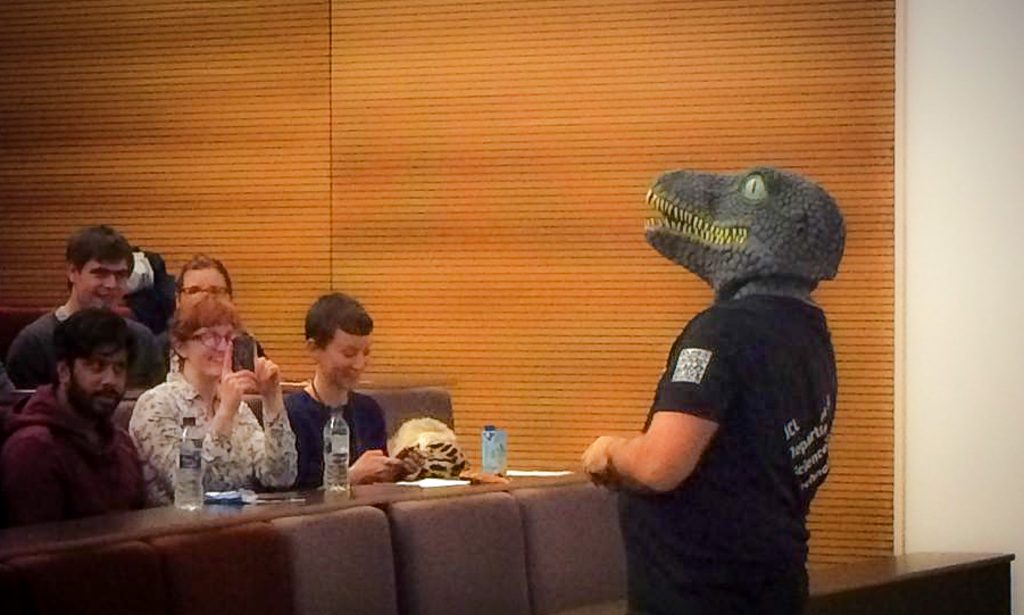
As the person introducing the films, I developed a schtick that became an audience favourite. I love talking about films, but I know most people really don’t like listening to that for very long. As compensation, I always brought along my favourite “film studies hat”. The idea was, if you can’t stand the academic stuff, just sit back, relax, and look at the hat. The hat changed with every film. For 20,000 Leagues Under the Sea (1916), I wore a scuba mask. For Inherit the Wind(1960), I wore a bishop’s mitre. For The Valley of Gwangi (1969), I wore a 50-gallon foam Stetson. For Creature From The Black Lagoon (1954), I wore a hat in the shape of a stuffed flamingo. I think for The Blob (1958), I wore a black plastic bin liner.
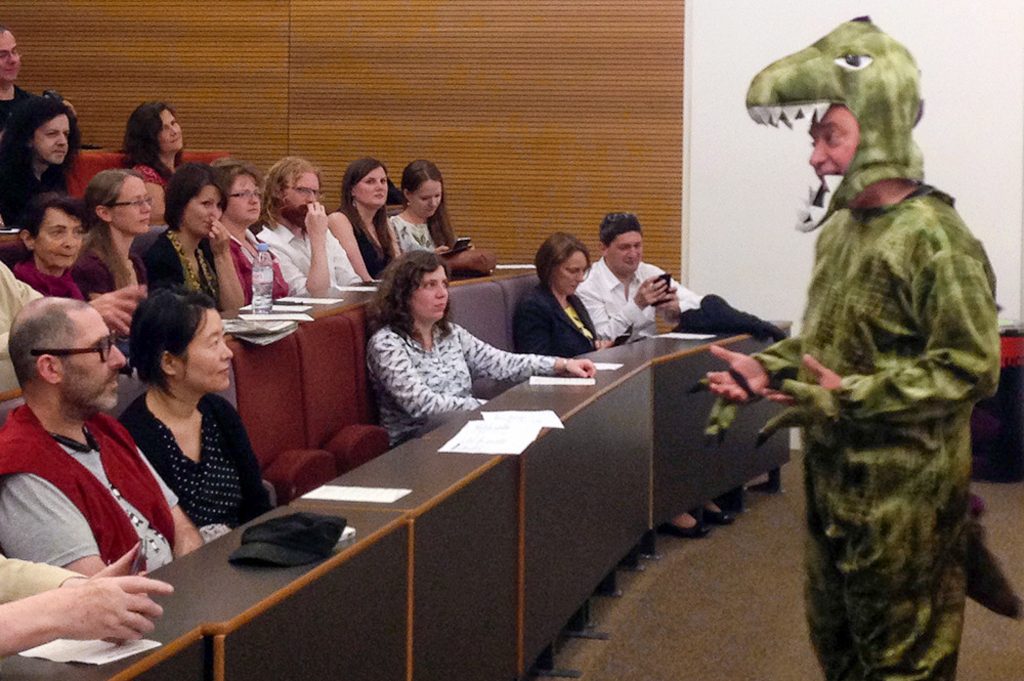
I remember one mask didn’t have much of a breathing hole, and I nearly collapsed. Lecturing while wearing a scuba mask proved harder than expected as it quickly fogged over, and I couldn’t see where the audience was. For the finale of the series, a repeat of the first film we ran, The Lost World (1925), I jumped into a full-size lizard costume. It was a complicated manoeuvre, and I didn’t want to struggle in front of the audience. I practiced and practiced for a smooth performance on the night. Once in, the suit was surprisingly comfortable. I could have stayed in it all night.
The film studies hat became a signature feature of Film Night at the Grant Museum, if only because it was silly, unexpected, and decidedly not academic. This was deliberate. I used the hats as a tool to put people at ease, to bond the audience together as a group laughing at that ridiculous academic at the front of the room. I also used it to give audience members a bit of material to add to their own social capital. On social media, we always saw posts along the lines, “I went to this event at UCL, and there was this absurd bit with a hat. A cardboard box covered in foil!?!” [That was for War of the Worlds (1953).]
Film Choices
After a few years, we had exhausted our list of “must show” films. We resisted the temptation to show high-brow art house films or films with overly preachy messages. I felt audiences had plenty of opportunities to engage those elsewhere in London and at UCL. Overly worthy projects and those that pounded viewers just didn’t seem useful for our objectives with this one series. We also avoided derivative, C-list films: schlock for schlock’s sake. We thought a lot about the value proposition of Film Night at the Grant Museum
Films in the Film Night Series
I don’t remember when Film Nights at the Grant Museum began. I think it was around 2006, not long after I organised a UK premiere of Randy Olsen’s Flock of Dodos (2006), about the politics surrounding intelligent design in the US. We started with The Lost World (1925), no hat. Then King Kong (1933), monkey mask. Then …
Here is an ABC list of the films we ran in the Film Night series:
- 20,000 Leagues Under the Sea (1954)
- Animal Farm (1954)
- Beast from 20,000 Fathoms (1953)
- Blob, The (1958)
- Behemoth (1959)
- Call of the Wild (1935)
- Cane Toads: An Unnatural History (1988)
- Creature from the Black Lagoon (1954)
- Dr. Jekyll and Mr. Hyde (1931)
- Empire of the Ants (1977)
- Fantastic Voyage (1966)
- Fly, The (1958)
- Frankenstein (1931)
- Gojira [Godzilla] (1954)
- Incredible Shrinking Man (1957)
- Inherit the Wind (1960)
- Island of Lost Souls (1932)
- Killer Shrews, The (1959)
- King Kong: The Eighth Wonder of the World (1933)
- Lost World (1925)
- Lost World (1960)
- One of Our Dinosaurs is Missing (1975)
- Planet of the Apes (1968)
- Quatermass and the Pit (1967)
- Sanders of the River (1935)
- Skippy: The Bush Kangaroo (1968)
- Tarzan (1959)
- Them! (1954)
- This Island Earth (1955)
- Three Ages, The (1923)
- Twenty-thousand Leagues Under the Sea (1916)
- Under the Caribbean (1954)
- Valley of Gwangi (1969)
- War of the Worlds (1953)
- When Worlds Collide (1951)
- Wolf Man (1941)
Reflection
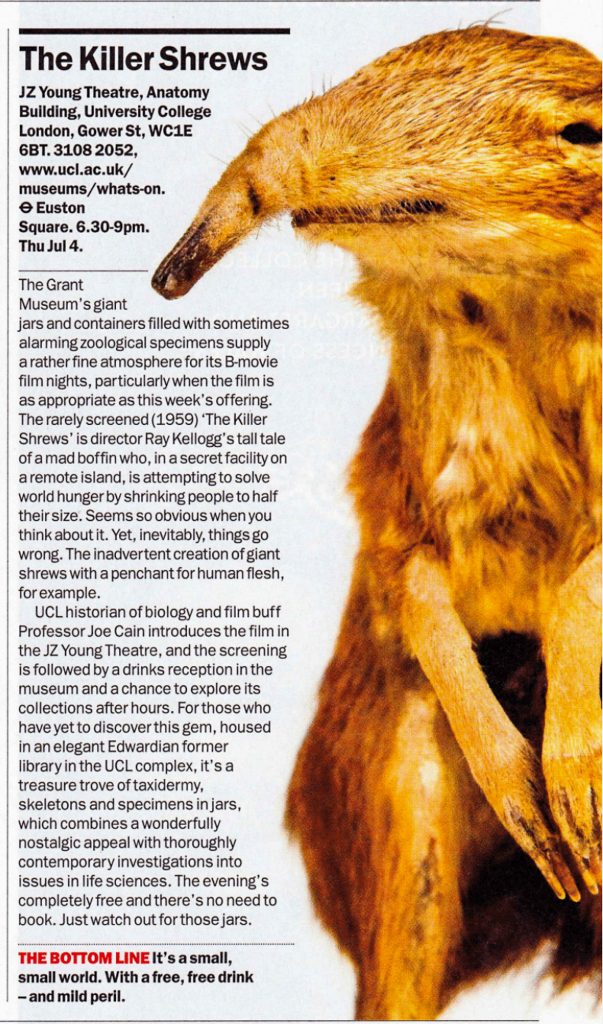
I think the largest audience we had for a Film Night was for The Killer Shrews (1959), a truly awful film that we advertised honestly as crap. The weekly events magazine Time Out promoted the event. It was high-summer, and we just thought it was time for a laugh. Yes, there are Cold War associations in the film. Yes, there’s a moral tale about Nature biting back. Yes, it was filmed outside Dallas, Texas, and there are tenuous associations with the later assassination of US President John Kennedy. It was a full house that night. The lecture hall shook with laughter. It was brilliant because the audience brought their best spirits. Ultimately, The Killer Shrews shows us just how hard it is to make a film – any film – in the first place. Try it.
One the surprise features of Film Night at the Grant Museum was the scale of attendance overall. This was in the early days of streaming, and cheap DVDs were very easy to find. Why travel across a busy city on a raining Thursday night to see a B-list old film or one easily viewable in the comfort of your own home?
I think the answer was community. A bit of film-loving. A bit of museum devotion. A bit of nostalgia linked to the university. A bit of light intellectualising. All this contributed. But I also think there was something about sitting together in a cinema space; laughing with other people; gasping with surprise together; finally seeing some famous scene; feeling you had permission to be smart or happy or thrilled along with the rest of us in the room.
In some ways, we were resisting the trend towards home cinema. In other ways, we were fighting passive viewing. For myself, I loved the waves of audience response. And the occasional interjection that was spot on for the moment. I learned an enormous amount about some films from conversations afterwards.
Sit in any crowded cinema for a blockbuster film and feel the sense of shared experience. No home-viewing experience comes close.
We ended the series after about 10 years because I felt the events were becoming stale. Audiences had many repeat attendees, but newcomers were notably on the decline. I thought the educational elements were dissipating, too. In the world of public engagement, other issues were rising in central attention, and I thought big groups laughing while watching films wasn’t the best way to proceed.
We had a big audience for the last night of the series. It was a grand send off, and I was deeply touched. It all ended with the audience giving a room-shaking round of applause. I don’t think they noticed at the time that they really were applauding themselves. Quite rightly. On a dark, cold, raining night mid-week, it’s takes real commitment to travel to Gower Street for uncomfortable seat and a glass of so-so UCL wine. But they came anyway. To think. To feel. To rise and fall. To float in the suspension of disbelief. To add a few more bits of knowledge and understanding about the human experience.