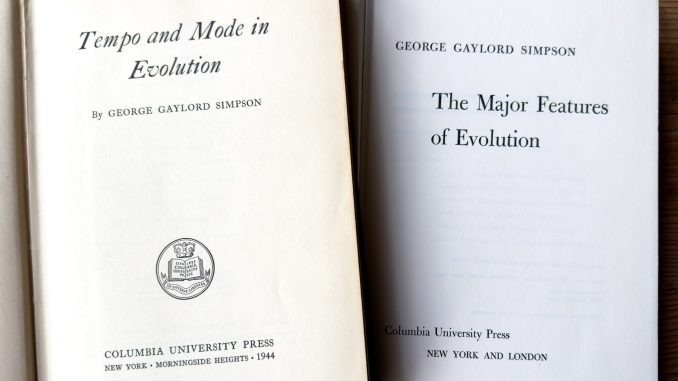
This post compares two of George Gaylord Simpson’s major theoretical works: Tempo and Mode in Evolution (1944) and Major Features of Evolution (1953). Both were published by Columbia University Press in their Columbia Biological Series. Both books played an important part in the expansion of evolutionary studies in post-WW2 America and Britain, commonly referred to as the synthesis period in evolutionary biology.
In August 2026, I posed a series of questions to the Generative AI software, Google Notebook LM (now Gemini Notebook), about the text itself. One feature of this LLM is the ability to largely restrict content knowledge to a user-defined library, though some leakage is notable. In this case, that library consisted solely of the single volume described here. The replies are reproduced in full here.
Audio summary
This LLM also has capacity to produce AI-generated voice “deep dives” into the source materials. These are structured to sound as if two humans are having a debate. The prompt is “Compare these two books in terms of their overall content and emphasis. Identify similarities and differences between the two books. In the debate, one side presents the two books as developing more or less the same theoretical position while the other side presents them as significantly different (perhaps an improvement of ideas, or an abandonment of some ideas).”
Compare Simpson’s 1944 and 1953 books. What are the main similarities and differences?
George Gaylord Simpson’s 1953 book, The Major Features of Evolution, was written as a comprehensive, modernized replacement for his 1944 work, Tempo and Mode in Evolution. While the 1953 text preserves the fundamental framework and arguments of the 1944 original, it significantly expands its scope, refines its terminology, and integrates a much broader array of biological evidence.
Main Similarities
- Core Concepts (Tempo and Mode): Both books are built upon the dual analysis of the rates of evolutionary change (tempo) and the phylogenetic patterns of that change (mode). Both works categorize evolutionary rates into three distinct distributions: horotely (standard or modal rates), bradytely (exceptionally slow or arrested evolution), and tachytely (exceptionally rapid evolution).
- The Adaptive Grid: To conceptualize how populations interact with their environments, both books utilize the model of an adaptive grid, which visualizes ecological opportunities as a dynamic landscape of broad zones and narrower subzones that populations move through, occupy, or shift between.
- Mechanisms of Change: Both texts firmly reject metaphysical theories of “orthogenesis” (predetermined, straight-line evolution) and “saltation” (the sudden origin of new major taxa via massive leaps). Instead, Simpson consistently argues that macro-evolutionary changes are driven by the accumulation of small, continuous mutations guided by natural selection within populations.
- Key Examples: Both books rely heavily on the fossil record of horses (Equidae) to demonstrate branching, shifting rates, and adaptive trends. Similarly, both contrast pelecypods and land carnivores to illustrate differing group rates of survivorship, and utilize Drosophila to bridge theoretical population genetics with paleontological findings.
Main Differences
- Expanded Scope and Botanical Evidence: The most significant difference in the 1953 book is its vast expansion of evidence. While the 1944 book focused largely on zoology and paleontology, the 1953 book integrates extensive botanical evidence. Relying heavily on the work of G. Ledyard Stebbins, Simpson incorporates data on plant evolution—such as polyploidy, apomixis, and reproductive hierarchies—to show how it mirrors or differs from animal evolution.
- Refinement of Evolutionary Modes: In 1944, Simpson classified the three modes of evolution as speciation, phyletic evolution, and quantum evolution. In 1953, he revises this framework:
- Splitting vs. Speciation: He replaces “speciation” with “splitting” as the basic mode of phylogenetic branching. He notes that “speciation” had caused confusion because, to geneticists, it strictly refers to the origin of genetic isolation, whereas “splitting” better describes the broader phylogenetic pattern of lineage separation.
- Quantum Evolution Reclassified: In 1953, Simpson clarifies that quantum evolution is not a completely distinct mode of evolution, but rather a “special, more or less extreme and limiting case of phyletic evolution” involving an all-or-none shift across an unstable adaptive threshold.
- Terminology (Prospective Adaptation): In the 1953 book, Simpson proposes the term “prospective adaptation” to replace the older term “preadaptation.” He argues that “preadaptation” had become burdened with unacceptable mutationist or teleological implications, whereas “prospective adaptation” acts as a more neutral, descriptive term for characteristics that make a future change in adaptation possible.
- New Examples and Data: The 1953 book introduces several new biological examples to quantify and illustrate its concepts. Lungfishes (Dipnoi) are introduced to demonstrate how to score and measure the rate of a whole “character complex” rather than just a single unit character. Centric diatoms are used to provide extreme statistical examples of bradytely, and taeniodonts are heavily analyzed to illustrate the mechanics of quantum evolution.
- Theoretical Adversaries: While the geneticist Richard Goldschmidt (and his theory of “systemic mutations”) remains a primary target of critique in both works, the 1953 book heavily targets the paleontologist O. H. Schindewolf. Simpson systematically dismantles Schindewolf’s “typostrophic” theories, which posited that higher taxonomic categories arise instantaneously through major saltatory leaps.
Is there major content Simpson removed between these two books?
While Simpson preserved the fundamental framework of his 1944 original, he did not merely revise the older text; he considered the 1953 volume an entirely new book. He noted that “practically all the original sentences [were] discarded or rewritten,” the selection of topics was expanded, and the overall sequence was radically modified.
Rather than removing core biological concepts, the major content Simpson “removed” consisted of speculative assertions and specific terminologies that had caused confusion or been outgrown by the rapid advancement of evolutionary synthesis between 1944 and 1953.
The most significant specific removals and replacements include:
- The terms “Micro-evolution,” “Macro-evolution,” and “Mega-evolution”: Simpson completely abandoned these terms in 1953, calling them “somewhat monstrous terminological innovations”. He removed this framework because it falsely led some readers to believe there were qualitatively different sorts of evolution. Instead, he shifted to discussing evolution across a continuous scale of specific taxonomic levels (e.g., subspecific, familial, ordinal).
- “Speciation” as a primary evolutionary mode: In 1944, Simpson classified the three modes of evolution as speciation, phyletic evolution, and quantum evolution. In 1953, he removed “speciation” from this list and replaced it with “splitting”. He did this because his earlier usage caused misunderstanding among geneticists, who use “speciation” strictly for the origin of genetic isolation between populations, whereas Simpson was referring to the broader phylogenetic pattern of lineage branching.
- “Quantum evolution” as a completely distinct mode: While the concept survived, Simpson removed its status as a fully independent third mode of evolution. In 1953, he clarified that it is not a different sort of evolution from phyletic evolution, but rather a special, extreme, and limiting case of phyletic evolution that occurs when a population shifts across an unstable threshold to a new adaptive zone.
- The term “Preadaptation”: Simpson proposed abandoning this term in favor of “prospective adaptation”. He felt the older term had become too burdened by its association with rigid mutationist theories and unwanted teleological (predestined) implications.
Ultimately, Simpson removed much of the 1944 book’s “speculative” nature, which he felt was a necessary byproduct of attempting to bridge genetics and paleontology when such a synthesis was still a relatively new and untested idea. The removed speculations were compensated for by what he called the “increased solidity” of the 1953 text.
Compare and contrast Simpson’s treatment of “quantum evolution” in his 1944 and 1953 books.
George Gaylord Simpson’s treatment of “quantum evolution” undergoes a notable refinement between his 1944 and 1953 books, maintaining its core descriptive characteristics while significantly shifting its theoretical and classificatory framework.
Main Similarities In both his 1944 work, Tempo and Mode in Evolution, and his 1953 revision, The Major Features of Evolution, Simpson defines quantum evolution as a relatively rapid, “all-or-none” shift of a population from a state of disequilibrium (or an ancestral adaptive zone) to a completely new and distinctly different equilibrium.
Both books present this mechanism as the primary explanation for the systematic gaps found in the fossil record. Because transitional populations cannot persist in the highly unstable intermediate state between two discrete adaptive zones, they must either complete the shift rapidly or die out, meaning intermediate forms are almost never preserved as fossils. Furthermore, Simpson consistently attributes quantum evolution to small, isolated populations subjected to intense selection pressure. Throughout both texts, quantum evolution is recognized as the dominant and most essential process responsible for the emergence of higher taxonomic categories (such as families, orders, and classes) and the explosive opening phases of adaptive radiations.
Main Differences Despite these descriptive similarities, Simpson’s theoretical interpretation of the mechanisms driving quantum evolution changed substantially between the two publications:
- Classification as a Mode: The most structural difference is its taxonomic status. In 1944, Simpson presented quantum evolution as one of three fundamental, distinct modes of evolution, standing alongside speciation and phyletic evolution. By 1953, he explicitly revised this classification, arguing that quantum evolution is not a completely separate sort of evolution, but is instead a “special, more or less extreme and limiting case of phyletic evolution”.
- The “Inadaptive Phase” and Genetic Drift: In his 1944 book, Simpson divided the quantum step into three strict phases: an inadaptive phase (where equilibrium is lost), a preadaptive phase, and an adaptive phase. He heavily stressed the inadaptive phase, suggesting that the shift was typically initiated by random genetic drift in small populations, which led to the fixation of inadaptive or nonadaptive mutations before selection could take over. In 1953, Simpson significantly de-emphasized this nonadaptive trigger. While acknowledging that genetic drift might occasionally initiate the shift by fixing a “key mutation,” he concluded that drift is “certainly not involved in all or in most origins of higher categories”. He revised his stance to argue that the transition usually arises adaptively and is oriented by selection throughout, making an entirely inadaptive phase unnecessary.
- The Threshold Effect: To replace the emphasis on a purely inadaptive phase, the 1953 book heavily develops the concept of an unstable adaptive threshold. Rather than a population wandering randomly until it hits a new selective current, Simpson remodeled quantum evolution as a “break-through from one position of stabilizing selection to another”. The threshold represents a point of unstable equilibrium where selection for the old ancestral adaptation perfectly balances against selection for the new one. Once this threshold is crossed, continuous and intense selection drives the rapid, all-or-nothing change to the new evolutionary equilibrium.
Compare and contrast Simpson’s treatment of phyletic evolution in his 1944 and 1953 books.
Core Similarities In both the 1944 and 1953 books, Simpson defines phyletic evolution as the sustained, directional (though not necessarily rectilinear) shift of the average characters of an entire population or lineage over time, explicitly distinguishing it from the dividing or branching of populations. He consistently treats it as the mode in which evolution tends to be most strictly adaptive and essentially nonrandom, driven by natural selection to maintain an organism’s adaptation to its environment.
Both texts establish that phyletic evolution typically occurs within continuously moderate to large breeding populations deployed within a broad adaptive zone. Furthermore, both volumes note that the continuous sequences characteristic of phyletic evolution provide the primary paleontological data from which standard (horotelic) and exceptionally slow (bradytelic) rates of evolution are inferred. Simpson also consistently highlights a practical taxonomic challenge unique to this mode: the successive species and genera produced by phyletic evolution are fundamentally different from contemporaneous species because they are merely arbitrary segments drawn across a single, continuous biological lineage.
Key Differences The primary difference between the two books lies in how Simpson classifies phyletic evolution within his overall theoretical framework, specifically regarding its relationship to his other designated modes of evolution.
- The Subsumption of Quantum Evolution: In 1944, phyletic evolution was presented as one of three distinct, fundamental modes of evolution, standing alongside speciation and quantum evolution. While he noted that certain phyletic shifts in adaptive type “intergrade” with quantum evolution, they were kept as structurally separate categories. In 1953, Simpson significantly broadened his definition of phyletic evolution to encompass quantum evolution, reclassifying it as a “special, more or less extreme and limiting case of phyletic evolution”.
- The Four-Part Spectrum of 1953: To reflect this broadened scope, the 1953 text formally divides phyletic evolution into four points along a continuous scale representing the maintenance of adaptation: (1) arrested evolution in a stable environment, (2) sustained trends corresponding with secular environmental change, (3) casual and episodic change, and (4) quantum evolution involving a rapid shift to a new adaptive zone. In 1944, he had listed three roughly analogous subtypes of phyletic evolution, but explicitly kept quantum evolution distinct as “the next mode”.
- Contrast with “Splitting” vs. “Speciation”: In 1944, phyletic evolution was contrasted directly with “speciation”. In 1953, acknowledging that his earlier use of the word “speciation” caused confusion among geneticists, Simpson explicitly replaces it with “splitting” to designate the branching element of phylogeny. He clarifies that speciation is merely the lower-level genetic mechanism that initiates splitting, while phyletic evolution governs the continuous transformation of the un-split lineages.
Compare and contrast Simpson’s treatment of speciation (or splitting) in his 1944 and 1953 books.
Similarities In both his 1944 and 1953 books, George Gaylord Simpson describes the branching of phylogenetic lineages as one of the three fundamental modes of evolution. His descriptive and ecological framework for this process remains highly consistent across both works:
- The Adaptive Grid: Both texts place this mode on the “subzonal” level of the adaptive grid. It occurs when a widespread population undergoes local differentiation or spreads into adjacent minor ecological niches.
- Evolutionary Pattern: Simpson consistently characterizes this mode as shifting, erratic, and not typically linear. Because the populations remain genetically similar for a long time, the differences that arise are essentially reversible until definite isolation occurs.
- Genetic Materials: In both volumes, he notes that this branching process draws primarily on the pre-existing store of genetic variability within the population, rather than relying on new, major mutations.
Differences The primary differences between the two books regarding this mode are terminological and conceptual, driven by Simpson’s desire to align his evolutionary framework more closely with the precise definitions used by population geneticists.
- Change in Terminology (“Speciation” vs. “Splitting”): In his 1944 book, Simpson named this entire broad mode of phylogenetic branching “speciation” (and noted it included “raciation,” or subspecies formation). In the 1953 book, he explicitly abandons this, re-labeling the mode as “splitting”.
- Clarifying the Definition of Speciation: Simpson explains in 1953 that his 1944 usage caused misunderstanding because geneticists restrict the word “speciation” strictly to the origin of genetic isolation between populations and the differentiation of characters within them. To resolve this, the 1953 text restricts “speciation” to the literal origin of species, defining it not as the broad evolutionary mode itself, but merely as the basic mechanism that initiates splitting.
- Refining the Boundary with Phyletic Evolution: In 1953, Simpson makes a much sharper structural distinction between splitting and phyletic evolution. He clarifies that while speciation initiates a split, the subsequent, sustained divergence of those separated lineages is not strictly speciation, but is actually an aspect of phyletic evolution.
Compare and contrast Simpson’s treatment of Sewall Wright’s work in his 1944 and 1953 books.
George Gaylord Simpson consistently uses the mathematical models of Sewall Wright to bridge the gap between theoretical population genetics and the paleontological fossil record. While Wright remains a foundational authority in both books, Simpson’s 1953 work presents a much more nuanced, defensive, and updated application of Wright’s theories, particularly concerning the role of “genetic drift.”
Core Similarities in Both Books In both Tempo and Mode in Evolution (1944) and The Major Features of Evolution(1953), Simpson relies on Wright to explain the mechanics of evolutionary rates and population structures:
- The Adaptive Landscape: Simpson enthusiastically adopts Wright’s pictorial metaphor of an “adaptive landscape” characterized by peaks (adaptive optima) and valleys (inadaptive zones) to explain how natural selection acts centripetally, centrifugally, or linearly on populations.
- Optimal Population Structure: Relying on Wright’s calculations of mutation ($u$), selection ($s$), and effective population size ($N$), both books conclude that very small, isolated populations suffer from random, inadaptive changes leading to extinction, while massive panmictic populations evolve too slowly. Both agree that the ideal condition for rapid, sustained evolution is an intermediate-sized population, or a large population subdivided into semi-isolated local groups.
Contrasts and Shifts in the 1953 Book By 1953, Simpson integrates a decade of Wright’s newer publications (up to 1950) and significantly shifts his own interpretation of Wright’s work in response to the scientific community’s reactions:
- Defending Wright Against Misinterpretation: In the years between the two books, a major controversy arose over genetic drift (the “Sewall Wright effect”). In the 1953 book, Simpson actively defends Wright against critics who believed Wright had assigned a preponderant role to genetic drift in small, fully isolated populations. Simpson clarifies that Wright explicitly did not do this, but rather emphasized that drift serves a positive “exploratory” role mainly when operating alongside selection within the partially isolated “demes” of a larger species.
- De-emphasizing Drift in Quantum Evolution: In 1944, Simpson relied heavily on Wright’s concept of genetic drift to explain the initial, unstable “inadaptive phase” of quantum evolution—the process by which a population loses its ancestral equilibrium and crosses into a new adaptive zone. By 1953, Simpson scales back this reliance, explicitly stating that “genetic drift is certainly not involved in all or in most origins of higher categories”. While he acknowledges that drift might occasionally initiate a “key mutation,” he pivots to the concept of shifting selective thresholds, concluding that the transition is usually adaptively oriented by selection from the start.
- Refuting Typostrophism via Wright: In 1953, Simpson uses Wright to attack O. H. Schindewolf’s typostrophic theory, which posited that new major groups arise instantly via massive single mutations (“saltations”). When Schindewolf attempted to cite Wright in support of his theories, Simpson explicitly pointed out that Wright’s agreement was strictly figurative and that Wright’s statistical genetics fundamentally opposed the idea that higher categories arise in one step without the ordinary processes of selection and speciation.
- Formalizing Population Dynamics: The 1953 text introduces a more mathematically robust handling of Wright’s models, incorporating terms like “demes” and Wright’s $m$ factor (cross-breeding pressure or genetic migration) to explain how variability is preserved and utilized across subdivided populations.
Compare and contrast Simpson’s treatment of Theodosius Dobzhansky’s work in his 1944 and 1953 books.
In comparing George Gaylord Simpson’s 1944 Tempo and Mode in Evolution with his 1953 revision The Major Features of Evolution, his treatment of Theodosius Dobzhansky reveals both a consistent foundational reliance and a significant evolutionary shift reflecting a decade of rapid advancement in population genetics.
Core Similarities in Both Books In both works, Dobzhansky serves as Simpson’s primary bridge between paleontology and modern experimental genetics. Simpson uses Dobzhansky’s research to consistently anchor his arguments in neo-Darwinian mechanisms:
- The Raw Material of Evolution: In both books, Simpson relies heavily on Dobzhansky to argue that small, continuous mutations are the primary raw material for evolutionary change, directly contrasting this with Richard Goldschmidt’s theories of sudden leaps via “systemic mutations”.
- Chromosomal Restructuring: Both texts use the exact same 1936 studies by Dobzhansky (with C. C. Tan and A. H. Sturtevant) on Drosophila pseudoobscura and D. miranda to prove that visually similar or identical species can have radically different chromosome arrangements, demonstrating that major chromosomal restructuring does not inherently produce sudden, major evolutionary leaps.
- Mutation Rates and Effects: Dobzhansky is frequently cited in both texts to provide laboratory estimates of mutation rates, to confirm the existence of a vast pool of variability in wild populations, and to show the multiple (pleiotropic) or systemic effects of single genes.
Key Differences and Shifts in the 1953 Book By 1953, the “modern synthesis” of evolutionary theory had solidified. Simpson’s use of Dobzhansky expands from using him to establish basic genetic mechanisms (in 1944) to using his newer research as direct observational proof of evolutionary dynamics in the wild:
- From Theory to Direct Proof of Selection: In 1944, Simpson used Dobzhansky to confirm theoretical mutation rates and to show that theoretical genetics were beginning to be correlated with wild populations. By 1953, Simpson triumphantly cites Dobzhansky’s 1947–1948 experiments with Drosophila in “population cages” and his observations of wild populations to provide “direct evidence of genetical selection” and rapid, short-range cyclic adaptive changes to seasonal environments.
- Tracking the Evolution of Dobzhansky’s Thought: The 1953 book engages with the revisions Dobzhansky made in the later editions of Genetics and the Origin of Species (1941, 1951). For example, Simpson notes that Dobzhansky had suggested in 1941 that low mutation rates might explain exceptionally slow (bradytelic) evolution, but points out that Dobzhansky “practically withdrawn” this suggestion in 1951, aligning with Simpson’s own view that slow evolution is due to selection rather than a lack of mutations.
- Broader Taxonomic Scope: While the 1944 book relied on Dobzhansky almost exclusively for Drosophila(fruit fly) data, the 1953 text utilizes Dobzhansky’s summaries of plant genetics. For instance, Simpson cites Dobzhansky’s 1941 discussion of cotton species to prove that taxonomic differences between species usually depend on many genes rather than single mutations.
- Balanced Polymorphism: In 1953, Simpson introduces the concept of “balanced polymorphism” (recently emphasized by Dobzhansky) to explain how populations can maintain a wide range of potential variability while remaining well-adapted to their current environment.
- Status as a Co-Architect of the Synthesis: In 1944, Dobzhansky is treated as a vital experimental geneticist. By 1953, Simpson explicitly places Dobzhansky’s 1951 volume among the monumental works that have produced a “veritable revolution” and a successful synthesis of paleontology, genetics, and systematics.
Compare and contrast Simpson’s treatment of Richard Goldschmidt’s work in his 1944 and 1953 books.
In both his 1944 work, Tempo and Mode in Evolution, and his 1953 revision, The Major Features of Evolution, George Gaylord Simpson treats the geneticist Richard Goldschmidt as his primary theoretical adversary. Simpson uses Goldschmidt’s theories as the ultimate foil for his own neo-Darwinian synthesis.
However, between the two books, Simpson’s treatment of Goldschmidt evolves from a direct attack on a newly published, dangerous theory to a more comprehensive dismissal of a concept that Simpson feels the scientific consensus has already rejected.
Core Similarities in Both Books In both books, Simpson systematically dismantles Goldschmidt’s strict dichotomy between “micro-evolution” (small adaptations within species) and “macro-evolution” (the origin of higher categories). Simpson consistently attacks Goldschmidt’s concept of “systemic mutations”—the idea that new species or higher taxonomic categories arise suddenly in a single step via radical chromosomal aberrations or “hopeful monsters”.
In both texts, Simpson asserts that the fossil record flatly contradicts Goldschmidt. He argues that macro-evolutionary changes are driven by the accumulation of smaller, continuous mutations guided by natural selection, not by massive leaps.
Simpson’s Treatment in 1944 In 1944, Goldschmidt’s The Material Basis of Evolution (1940) was a recent publication, and Simpson attacks its foundations aggressively:
- The “Fallacy” of Dichotomy: Simpson argues that it is a fundamental fallacy in Goldschmidt’s work to assume a clear-cut dichotomy between small gene mutations and large chromosomal mutations, stating that this assumption repeatedly leads Goldschmidt to non sequiturs.
- Reinterpreting Genetic Evidence: Simpson attacks Goldschmidt’s reliance on homoeotic mutants (e.g., fruit flies born with traits of other insect orders) as proof of systemic mutation. Simpson points out that a single mutation creating a misplaced wing does not miraculously create a completely new “reaction system” or a new genus.
- Misuse of Paleontology: Simpson harshly criticises Goldschmidt for claiming that paleontology supports saltation (sudden leaps). Simpson points out that Goldschmidt provides no actual paleontological facts and relies on a citation (O. H. Schindewolf) whose work actually contradicts Goldschmidt’s own conclusions.
Simpson’s Treatment in 1953 By 1953, the “modern synthesis” of evolutionary theory had solidified, and Simpson’s treatment of Goldschmidt reflects an ongoing debate spanning the intervening decade:
- Responding to Counter-Attacks: The 1953 book engages directly with critiques Goldschmidt published in 1945 and 1946 against Simpson’s 1944 book. For example, Goldschmidt argued that the gradual appearance of traits (like the “crochet” in horse teeth) was just a mutant of “low penetrance” and preferred this to Simpson’s “complicated constructions of the Neo-Darwinian scheme”. Simpson defends his fossil evidence, showing that traits genuinely fluctuate and segregate over time.
- Critique of Goldschmidt’s View on Adaptation: Simpson attacks new arguments made by Goldschmidt (1945) regarding mimicry. Goldschmidt claimed that highly intricate mimicry could not arise via selection because the final, tiny steps would have no selective advantage. Simpson dismisses this, demonstrating that very slight selective values are mathematically proven to be highly effective in natural populations.
- Pairing Goldschmidt with Schindewolf: While Goldschmidt stood somewhat alone as the geneticist adversary in 1944, in 1953 Simpson frequently pairs him with the paleontologist O. H. Schindewolf. Together, they represent the ultimate “saltationist” school that Simpson is determined to bury.
- Appealing to Scientific Consensus: A major shift in 1953 is Simpson’s note that Goldschmidt’s “systemic mutation” theory has been rejected by the consensus of geneticists in the twelve years since it was proposed. While acknowledging profound respect for Goldschmidt’s purely experimental genetics (citing Sewall Wright’s similar respect), Simpson dismisses his evolutionary hypotheses as unsupported.
- Discarding Goldschmidt’s Terminology: Finally, in 1953, Simpson completely abandons the terms “microevolution” and “macroevolution,” attributing their popularisation to Goldschmidt. Simpson calls them “somewhat monstrous terminological innovations” because they falsely trick readers into believing there are qualitatively different sorts of evolution rather than just different levels of the same continuous process.
Compare and contrast Simpson’s treatment of Otto Schindewolf’s work in his 1944 and 1953 books.
George Gaylord Simpson’s treatment of Otto Schindewolf shifts dramatically from a brief, somewhat defensive mention in 1944 to positioning him as his primary theoretical adversary in 1953. However, in both works, Simpson maintains a profound respect for Schindewolf’s intellect and empirical data, even while systematically dismantling his evolutionary theories.
The 1944 Book: A Minor but Respected Figure In Tempo and Mode in Evolution, Schindewolf appears briefly as a paleontologist who insists on taking the systematic discontinuities of the fossil record at “face value” to support theories of sudden evolutionary jumps. Interestingly, Simpson slightly defends Schindewolf against the geneticist Richard Goldschmidt. When Goldschmidt cites Schindewolf to back his own theory of instantaneous “systemic mutation,” Simpson notes that he carefully read Schindewolf’s 1936 paper and found that it actually contradicts Goldschmidt. Even while noting that Schindewolf’s views are at “wide variance with the consensus of paleontologists,” Simpson praises the work as having “great importance and value”.
The 1953 Book: The Primary Theoretical Adversary By the time The Major Features of Evolution was published, Schindewolf (having published major works in 1950) had become the leading paleontological exponent of saltation and “typostrophism,” effectively taking Goldschmidt’s place as Simpson’s main target for critique. Simpson attacks several of Schindewolf’s core arguments:
- Saltation vs. Continuity: Simpson heavily criticizes Schindewolf’s assertion that higher taxonomic categories (families, orders, classes) arise discontinuously via massive single mutations (“Grossmutation”). He specifically rebukes Schindewolf’s claim that the sudden appearance of early horses (Hyracotherium) is absolute proof of discontinuous origin. He also highlights the logical lengths Schindewolf goes to in order to maintain his theory of rigid boundaries between classes, noting that Schindewolf dismisses the famous reptile-bird intermediate Archaeopteryx as simply “a true bird” to artificially maintain the evolutionary gap.
- Racial Life Cycles: Simpson rejects Schindewolf’s “typostrophic” framework, which argues that groups pass through predetermined, cyclical phases modeled on an individual’s life span (typogenesis, typostasis, and typolysis).
- Evolutionary Rates: Simpson directly challenges Schindewolf’s calculations of evolutionary rates. When Schindewolf argues that ammonites evolved much faster than Simpson originally claimed, Simpson points out that Schindewolf biased his data by using exclusively short-lived “guide genera” (Leitgattungen) and a heavily split classification system, which naturally produces the illusion of faster rates.
The 1953 Book: Intellectual Respect and Reliance on Data Despite these fierce attacks, Simpson’s 1953 treatment is uniquely characterized by a deep, explicit admiration for Schindewolf. Simpson goes out of his way in a footnote to explain that his frequent criticisms are actually a compliment: Schindewolf is “among the few paleontologists… who have really broad grasp and subtle, theoretical minds,” meaning his views are “based… on real evidence and must be taken seriously”.
Furthermore, Simpson frequently relies on Schindewolf’s own empirical data to support the neo-Darwinian synthesis. He points out that Schindewolf’s survivorship data on gastropods, brachiopods, and foraminifera perfectly confirm his own pelecypod data. He cites Schindewolf’s refutation of the idea that evolutionary tempo is progressively quickening over geological time, and he heavily utilizes Schindewolf’s dating of evolutionary “turning points” to prove that biological crises do not perfectly correlate with worldwide geological or tectonic cycles.
In summary, in 1944, Schindewolf was a peripheral figure used mainly to show that Goldschmidt misunderstood his own paleontological sources. By 1953, Schindewolf was elevated to the status of a brilliant but misguided rival, whose theoretical conclusions Simpson fought vehemently, but whose meticulous data Simpson happily co-opted to strengthen his own arguments.
Compare the analysis of the 30 most frequently used and conceptually dominant scientific words (nouns, verbs, adjectives, and adverbs) that define Simpson’s 1953 text and Simpson’s 1944 text.
When George Gaylord Simpson expanded his 1944 classic Tempo and Mode in Evolution into his 1953 work, The Major Features of Evolution, he did not simply revise his previous text; he completely rewrote, expanded, and structurally modified his entire evolutionary framework. This transition is clearly reflected in the shifting vocabulary and conceptual prominence of the dominant scientific words between the two books.
1. Chief Unifying Vocabularies (The Core of the Synthesis)
Despite a decade of rapid biological discoveries between the two publications, a core set of words remains highly consistent across both texts, representing Simpson’s fundamental conceptual bridge between genetics and paleontology:
- Nouns: Population, Selection, Adaptation, Rate, Mutation, Variability, Equilibrium, and Discontinuity.
- Verbs: Evolve, Adapt, Diverge, Survive, and Shift.
- Adjectives: Adaptive, Phyletic, and Quantum.
These terms represent the permanent conceptual currency of Simpson’s work. In both books, they are used to analyze how the statistical models of population genetics operate within the physical, temporal boundaries of the fossil record. Whether discussing Hyracotherium or Kosmoceras, the central theme remains the creative power of selection acting upon the hereditary variability of populations.
2. Conceptual Vocabularies Dominant in the 1944 Text
Several dominant words and theoretical frameworks from the 1944 text were either de-emphasized or consciously discarded by Simpson in his 1953 volume:
- Tempo and Mode: While still serving as his underlying subject, the explicit, literal dualism of “Tempo” (the velocity of evolution) and “Mode” (the styles or patterns of change) is much more structurally dominant in the 1944 work.
- Inertia and Momentum: In 1944, Simpson dedicated a significant portion of his analysis to addressing and refuting mechanical analogies of evolution, evaluating whether lineages had physical “momentum” that caused them to overshoot their adaptive optima. By 1953, he favored more strictly biological, system-level explanations over mechanical metaphors.
- Mega-evolution and Macro-evolution: These Greek-prefixed scales of evolutionary magnitude (originally proposed by Goldschmidt) were central to the 1944 text. By 1953, Simpson explicitly retreated from them, calling them “somewhat monstrous terminological innovations” that had served their purpose and should be abandoned in favor of a more integrated, continuous view of evolutionary change.
3. Conceptual Vocabularies Expanded or Introduced in the 1953 Text
The 1953 text exhibits a much more formalized, systematic, and taxonomically integrated vocabulary:
- Horotely, Bradytely, and Tachytely: Although Simpson introduced these terms late in his 1944 text to describe normal, exceptionally slow, and exceptionally fast rates of evolution, they became fully integrated, systematically compared, and structurally dominant as distinct rate distributions and chapters in the 1953 work.
- Taxonomic, Category, Lineage, and Phylogeny: The 1953 volume leans much more heavily on the “new systematics”. Simpson increasingly substituted purely morphological terms with systematic terms like “category” and “taxonomic” to analyze the retrospecitve realities of the Linnaean hierarchy.
- Threshold and Splitting: To describe the mechanics of quantum and speciational evolution, Simpson’s 1953 text relies heavily on the concept of the “threshold”—the point of unstable equilibrium a population must cross to enter a new adaptive zone—and elevates “splitting” to a primary mode of lineage separation.
- Gradually (Adverb): While both books are strictly gradualist, the adverb “gradually” is used with greater strategic frequency in 1953 to counter the post-1944 rise of saltationist and typostrophic theories (such as Schindewolf’s) which claimed that higher categories arise in single, sudden leaps.
Map Simpson’s 1953 “adaptive grid” directly to his 1944 “selection landscapes” to compare examine how his visual representations of evolutionary pathways.
Simpson’s visual representation of evolutionary pathways evolved significantly between his 1944 “selection landscapes” and his 1953 “adaptive grid”. Both models serve as conceptual abstractions to represent the complex, non-random interactions between populations, genetics, and the environment, but they transition from a topographic, vector-based representation of physical force to an ecological, time-dimensional coordinate system.
1. Topographic Contours (1944) vs. Ecological Coordinate Bands (1953)
- 1944 Selection Landscape: This model uses a two-dimensional topographic contour map to plot structural variation. An adaptive optimum is represented physically as a hill or peak. The direction of positive selection is uphill, negative selection is downhill, and the selection intensity is proportional to the steepness of the slope.
- 1953 Adaptive Grid: Instead of topographical hills, the grid maps the course of adaptive history using a series of horizontal ecological bands (adaptive zones), with absolute time serving as the vertical dimension. The grid is divided into major bands, which are further partitioned into smaller, discrete bands and contiguous tracts.
2. Mapping Adaptive Optima and Tolerance
- Peak Height vs. Band Width: In the 1944 landscape, a sharp, high peak represents a highly specific, narrow adaptation, whereas a broad, lower peak represents a less specific, wider adaptation. In the 1953 grid, this is mapped directly by the physical width of the grid bands. The lower bands of the grid are wider, representing a broader zone of ecological tolerance and less specific specialization. Conversely, the higher bands are narrower, requiring highly specific adaptation that can easily become lethal if the environment changes.
- Centripetal Selection vs. Zonal Stability: In 1944, a population is held in stable adaptation by centripetal selection, which physically surrounds a peak to eliminate variant outliers and concentrate the population mean around the optimum. In 1953, this corresponds to zonal movement (horotelic or bradytelic evolution), where a population stably occupies a broad adaptive zone over time.
3. Crossing the Gaps: “Saddles” vs. “Interzonal Discontinuities”
- The 1944 Saddle: When a population shifts to a new adaptation, it must cross a saddle—a relatively inadaptive, unstable mountain pass between two peaks where it is subjected to centrifugal selection (forces driving it away from the ancestral mean) before rapidly climbing the slope of the new peak.
- The 1953 Interzonal Discontinuity: The saddle is directly mapped in 1953 as an interzonal discontinuity or an essentially unstable ecological zone separating the stable, major bands of the grid. Crossing this gap represents quantum evolution (a rapid, tachytelic shift). Because the transitional populations in these gaps are highly unstable, they do not persist, leaving “gaps” or discontinuities in the fossil record.
4. Gradual Splitting vs. Step-like Progression (Stufenreihe)
- Contour Division (1944): Splitting is represented in 1944 by a population contour line dividing on a slope to occupy two separate, adjacent adaptive peaks (such as the splitting of browsing and grazing horses).
- The Step-like Grid (1953): The 1953 grid explicitly maps how this splitting appears in the actual fossil record. It represents evolution as a step-series (Stufenreihe) of successive, static populations (A-E) that are preserved as fossils because they occupied stable, abundant zones. The actual, continuous lineages of the transition (Ahnenreihe) are rare, rapidly changing, and usually lost in the unstable gaps between the grid bands.
What is the source for the term “Stufenreihe”?
In Tempo and Mode in Evolution (1944), George Gaylord Simpson attributes the term “Stufenreihe” (meaning “step-series” or “step-like evolution”) to the Austrian palaeobiologist Othenio Abel, specifically citing his 1929 work, Paläobiologie und Stammesgeschichte.
Simpson uses the term “Stufenreihe” to describe a very common phenomenon in the paleontological record: the appearance of successive, distinct structural steps (represented by stable, abundant, and fossilised populations in successive adaptive zones), rather than the continuously transitioning, direct ancestral lineages (the Ahnenreihe). Because the transitional populations crossing the unstable gaps between these zones are rare and rapidly evolving, they are usually missing from the fossil record, leaving the “Stufenreihe” as an apparent but discontinuous structural sequence of steps.